

You've dimmed the lights, silenced your phone, and finally made it to the quiet part of the evening. Then comes the small dilemma: you want the warm glow and gentle fragrance of a candle, but you don't want a flame burning beside your bed for hours while you drift off.
That tension explains why choosing the best candles for sleep is less about finding the strongest lavender scent and more about understanding how a candle behaves in a bedroom. Scent intensity, wax, wick, ventilation, placement, and the timing of the ritual all matter. A candle can support a calming routine, but it shouldn't replace safe sleep habits or turn a small room into an enclosed cloud of fragrance and combustion particles.
Table of Contents
- Why Your Bedroom Candle Routine Matters More Than the Candle
- The Three Building Blocks of a Sleep-Friendly Candle
- What the Research Actually Says About Scent and Sleep
- Sand Wax vs Traditional Candles in the Bedroom
- How to Choose and Place a Candle for Better Sleep
- Building a Layered Bedtime Scent Ritual
- Common Sleep Candle Mistakes and Safer Alternatives
Why Your Bedroom Candle Routine Matters More Than the Candle
A typical bedtime candle looks appealing on a shelf. It may come in a beautiful jar, carry a “sleep” label, and promise a soothing fragrance. Yet the label doesn't tell you whether the scent will peak too quickly, whether the wick will produce a tall flickering flame, or whether the candle is practical to extinguish before you get into bed.
Consider a familiar evening. You light a jar candle while reading, brush your teeth, and prepare the room. At first, the fragrance is barely noticeable. Later, once the wax pool is fully formed, the scent becomes much stronger. In a small bedroom, that delayed intensity can feel less like relaxation and more like perfume pressed too close to your face.
The most useful bedtime candle has to fit the hour before sleep, not the entire night. Look for three types of predictability:
- Predictable scent release: The fragrance should remain mild enough that it doesn't distract you as the room grows quiet.
- Predictable burn-down: The candle should be easy to extinguish on schedule and shouldn't encourage an all-night burn.
- Predictable air conditions: You need enough ventilation to prevent fragrance and combustion emissions from accumulating.
Bedroom rule: A sleep candle is a wind-down tool, not an overnight appliance.
Traditional candles can create three bedroom-specific problems. Scent may peak before you're ready for bed. Liquid wax can drip, tunnel, or leave a difficult residue. An open flame creates uncertainty if you're tired, distracted, or already lying down. Burning candles can release PM2.5 and volatile organic compounds, including aldehydes and other irritants, and a 2025 study summary reported nearby PM2.5 reaching roughly 26 to 31 µg/m³ within 30 minutes from a single scented candle in the tested setting (HabitatMap's candle and incense air-quality summary).
The practical answer isn't to reject candlelight altogether. It's to choose a format that supports a short, repeatable ritual, place it carefully, ventilate the room, and extinguish it well before sleep. The right routine and placement matter more than any single fragrance name.
The Three Building Blocks of a Sleep-Friendly Candle
A candle's bedroom performance depends on three connected variables: scent profile, wax type, and burn quality. Think of them as parts of a song. The notes create the melody, the wax controls how gently the sound carries, and the wick determines whether the performance stays steady.
Scent profile
Fragrance notes unfold in layers. Top notes make the first impression and tend to feel light or fleeting. Citrus and mint often sit here. Heart notes form the central aroma, which is where lavender and chamomile commonly belong. Base notes linger longest and give the composition its grounding foundation, with examples such as cedar, sandalwood, and vanilla.
That layered structure matters in a bedroom. A sharp top note may feel refreshing in a kitchen but stimulating beside your pillow. A softer heart note can provide the familiar calming cue you want, while a restrained woody base keeps the fragrance from disappearing immediately.
Before choosing between fragrance oil and essential oil, consider how each is made, formulated, and tolerated in your space. This fragrance oil versus essential oils guide can help clarify the distinction without assuming that “natural” automatically means non-irritating.
Wax type
Wax affects the way fragrance and heat behave. Soy wax is generally softer, so it can provide a gentle scent release but may need careful burning to avoid uneven melting. Coconut wax is also soft and is often used for a slow, even melt. Beeswax is harder and can produce a steady, longer-lasting candle, while paraffin has become a concern for people who want to reduce petroleum-derived candle emissions indoors.
A softer wax is like a quiet speaker that fills a room gradually. A harder wax is more like a controlled, sustained note. Neither material automatically makes a candle suitable for sleep, because formulation, wick size, fragrance concentration, and ventilation still determine the result.
For sleepers who prefer candlelight without added fragrance, Baby Pink unscented Candle Sand 350g/0.73lbs offers a soft visual accent with an unscented, calming profile.
Burn quality
The wick is the candle's engine. Cotton wicks usually create a familiar, quiet flame. Wood wicks can add a subtle crackle, but their flame behavior depends on width, moisture, and trimming. Zinc-core wicks require particular attention because an oversized or poorly maintained wick can produce a taller, less controlled flame.
Use a fireplace as the analogy. A small, steady fire is easier to live with than a tall flame that flickers aggressively and leaves visible smoke. A wick that's too long can increase flame height and soot, while a properly trimmed wick helps the candle burn more consistently.
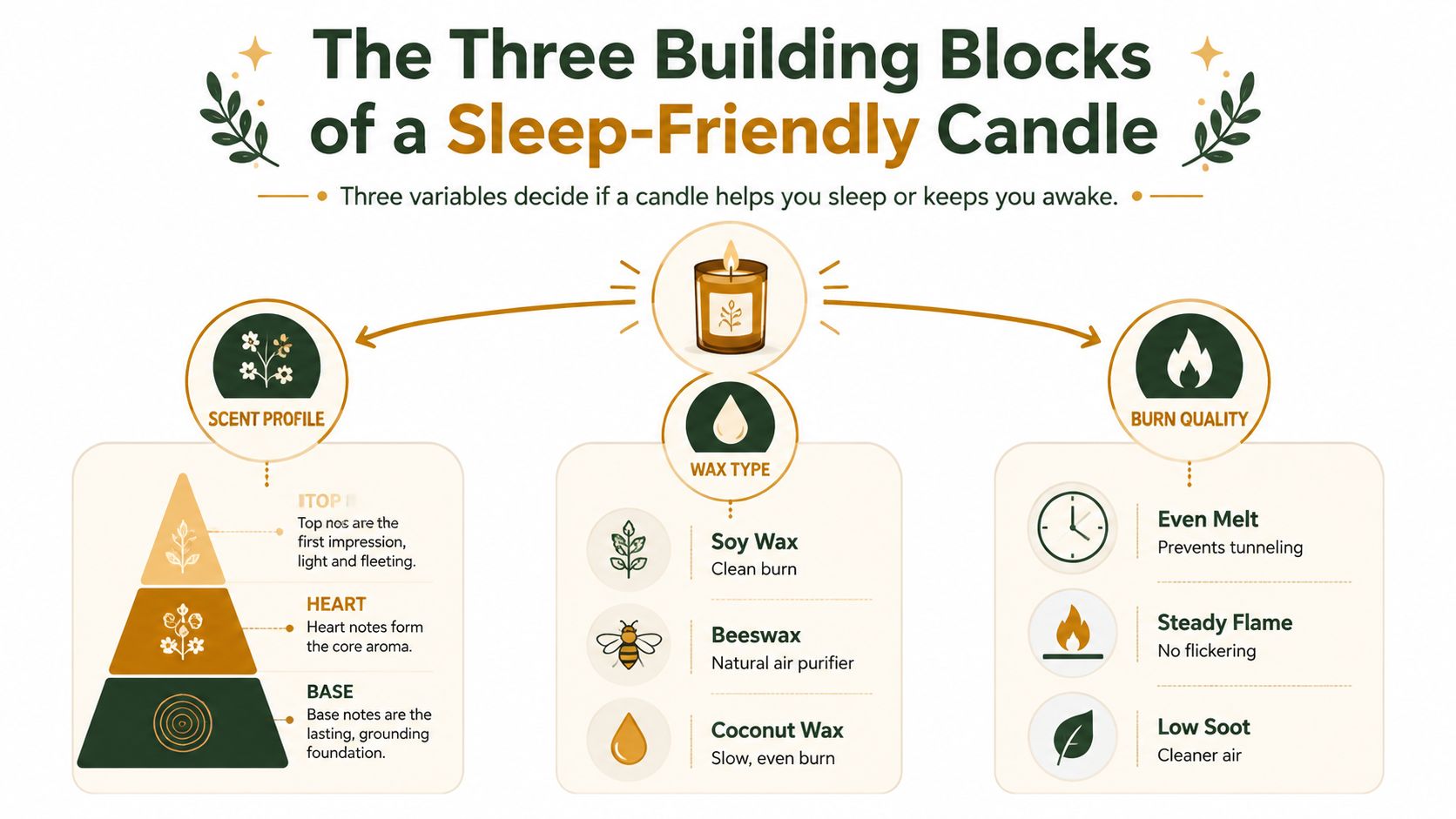
The usual sleep-friendly combination is a mild lavender-led or woody fragrance, a paraffin-free wax, and a steady cotton or well-maintained wood wick. But an unscented candle with warm light may be the better choice if fragrance gives you headaches or makes the room feel crowded.
What the Research Actually Says About Scent and Sleep
Aromatherapy has stronger support than many casual candle claims suggest, but the evidence needs careful translation. A large 2019 meta-analysis of 12 studies found that aromatherapy improved sleep quality, with a statistically significant overall random-effects estimate and a 95% confidence interval of 0.540 to 1.745. Its subgroup results also found that inhalation aromatherapy outperformed massage-based delivery, which is relevant because a scented candle works through airborne fragrance rather than skin contact (the PubMed analysis).
A broader 2021 systematic review of 34 studies concluded that aromatherapy was highly effective for sleep problems, including insomnia, and reported an overall effect size of 0.6491 (the systematic review in PMC). Updated review work and a later clinical trial continued to report positive outcomes from inhaled aromatherapy, including shorter time to fall asleep, better subjective sleep quality, and changes in sleep architecture.
Those findings support fragrance exposure as a potentially useful sleep cue. They don't prove that every scented candle works, and most research has examined diffusers, oils, or controlled inhalation rather than a burning candle in a bedroom.
| Scent note | Evidence strength | What studies measured |
|---|---|---|
| Lavender | Most repeated positive signal in sleep aromatherapy research | Sleep quality, sleep onset, relaxation-related outcomes |
| Chamomile | Supportive, but thinner evidence | Sleep-related comfort and calm in inhalation or other aromatherapy settings |
| Bergamot | Mixed and limited for sleep specifically | Anxiety and relaxation-related outcomes |
| Cedarwood and sandalwood | Limited but promising | Pilot and preclinical signals, rather than a settled candle-specific conclusion |
| Valerian | More established for oral use than inhalation | Sleep outcomes in forms that don't directly match candle use |
A 2024 preliminary study found that inhaling a lychee-scented soy wax candle for four weeks significantly improved sleep quality in adults and older adults, but it didn't reduce stress (the preliminary candle study). That result leaves an important distinction: a candle may improve a person's perceived sleep through relaxation and routine without producing a broad reduction in stress.
The sensible rule is modest. Choose a mild, familiar scent and use it consistently before bed. Treat the candle as a ritual cue, not an “essential oil cure,” and stop using it if the fragrance causes headache, congestion, coughing, or discomfort.
Sand Wax vs Traditional Candles in the Bedroom
Bedroom candle formats behave differently because they expose different amounts of molten wax, fragrance, and flame. A jar candle can offer a long, stable burn, but its scent throw may become excessive in a compact room, and the remaining wax isn't easy to replace with another fragrance. A pillar candle looks elegant but can melt unevenly, while tealights burn quickly and may tempt you to use several open flames at once.
Sand wax changes the mechanics. Granular wax sits inside a compatible, heat-resistant vessel, and the wick is placed into the surface. Independent candle-making guidance describes sand wax as a sand-like material that can be poured directly into a vessel and topped with a wick, with the wick typically set about 1/4 inch above the surface for proper burning (sand wax candle-making guidance).
Because the wax is granular, you can remove the used portion and refresh the vessel rather than scraping out a fixed wax block. Supply information also identifies sand wax as a distinct granular material, including plant-based commercial options, with final appearance depending on particle consistency and processing (granulated sand wax supply information).
| Format | Scent intensity | Refillable | Mess risk | Flame control | Bedroom fit |
|---|---|---|---|---|---|
| Jar candle | Moderate to strong, depending on formulation | Usually limited | Leftover wax remains | One enclosed flame | Suitable with careful timing and ventilation |
| Pillar candle | Moderate, often more exposed | No | Melt pools and drips are possible | More exposed flame | Decorative, but needs a stable tray |
| Tealight | Light to moderate | No | Small wax cup remains | Short-duration flame | Useful briefly, but multiple tealights add flame points |
| Sand wax | Adjustable, depending on amount and fragrance | Yes | Used wax can be removed from the vessel | Wick placement can be controlled | Practical for short rituals and reusable vessels |
A large event-focused retailer also describes granulated sand wax as suitable for event sand candles and direct pouring into compatible vases (event sand wax information). That makes the format relevant beyond bedrooms, but at home the main advantages are reusability, low cleanup, and flexible placement.
A deeper comparison of the mechanics appears in this guide to sand candles versus traditional candles. The choice still depends on your room, sensitivity, and willingness to maintain a flame safely.
How to Choose and Place a Candle for Better Sleep
Start with the room, not the product description. A strong scent that feels balanced in a large living area can become oppressive in a compact bedroom. For rooms under 12 square metres, choose a light scent throw. Save stronger fragrances for larger bedrooms with ventilation.
Use a buying checklist
Scent intensity comes first. If you can smell a candle immediately from across a shop, test it cautiously at home. Olfactory fatigue can make you add more fragrance or burn the candle longer, even when the room already feels saturated.
Choose the vessel for both safety and light. Glass, ceramic, and sand-filled vessels can contain the candle, provided they're heat-resistant and stable. Opaque materials reduce the visible glow, which may suit light-sensitive sleepers. A transparent glass vessel creates more ambience but can be distracting if you're sensitive to light.
Match burn time to the ritual. A candle marketed for a long total burn doesn't need to burn for the entire evening. A 20 to 30 hour candle can be sufficient for a pre-sleep routine, because the objective is a repeatable cue rather than all-night fragrance. Always follow the maker's safety guidance, and don't assume a longer total burn means a longer safe session.
Inspect the wick. Cotton and wood are common choices. Cotton tends to provide a familiar flame, while wood may add sound as well as light. Trim the wick to 5 mm before burning, and stop if the flame becomes unusually tall, smoky, or unstable.
Place it like an open flame
Keep the candle at least 1 metre from the bed, away from curtains, books, chargers, and loose clothing. Don't place it on a nightstand directly beneath a pillow, and use a heat-safe tray underneath the vessel.
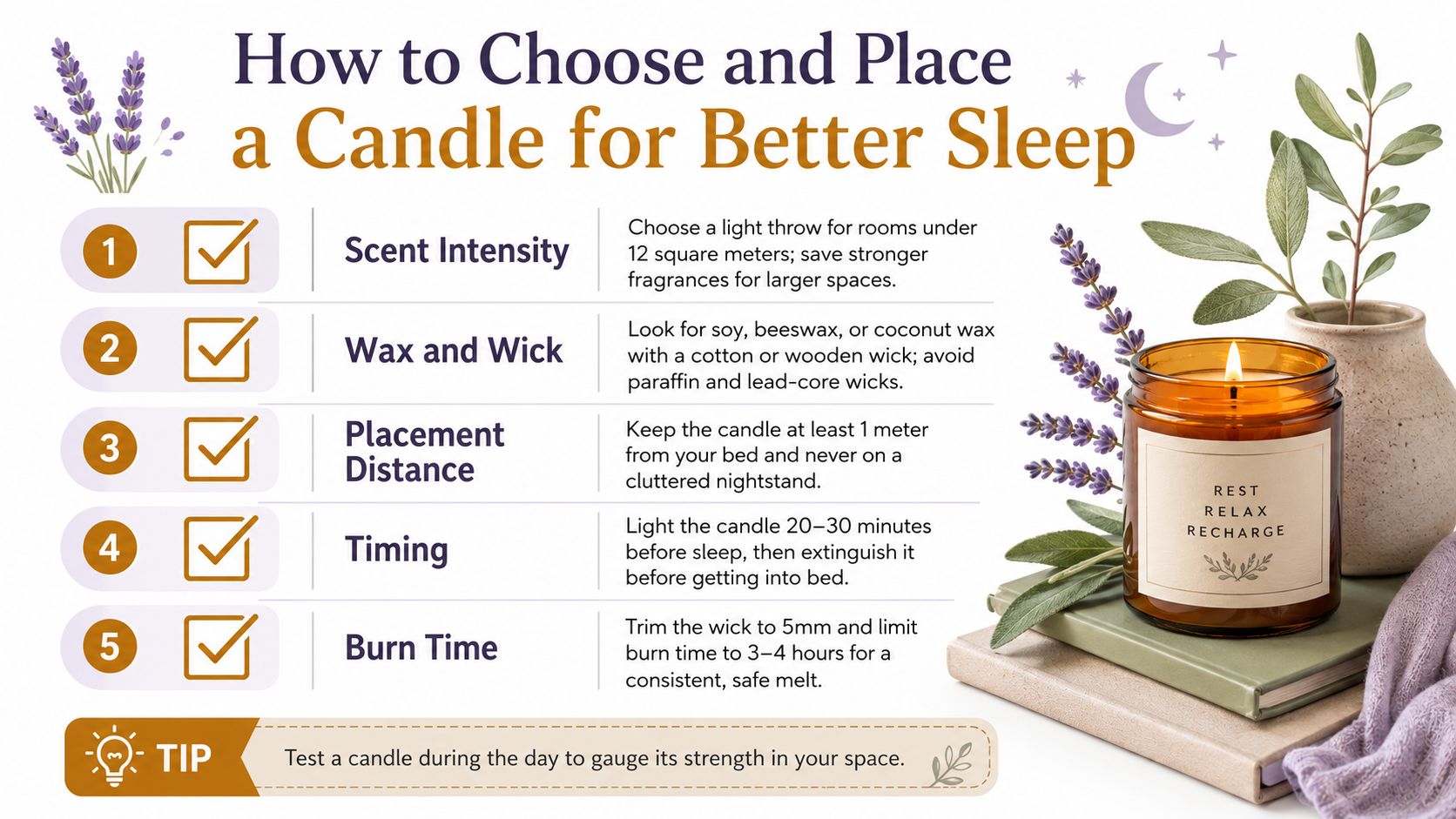
Light the candle before your final bedtime tasks, not after you're already under the covers. Ventilate the room, and extinguish the flame before you get into bed. The air-quality concern is especially important in poorly ventilated rooms with closed windows and blocked vents, where one study summary reported peak fine-particle concentrations reaching up to 15 times the World Health Organization limit (The Conversation's indoor air-quality explanation).
For broader bedroom planning, the Willis Furniture mattress buying guide connects lighting, temperature, mattress choice, and bedding, which is useful because a candle works best as one small part of the sleep environment.
Building a Layered Bedtime Scent Ritual
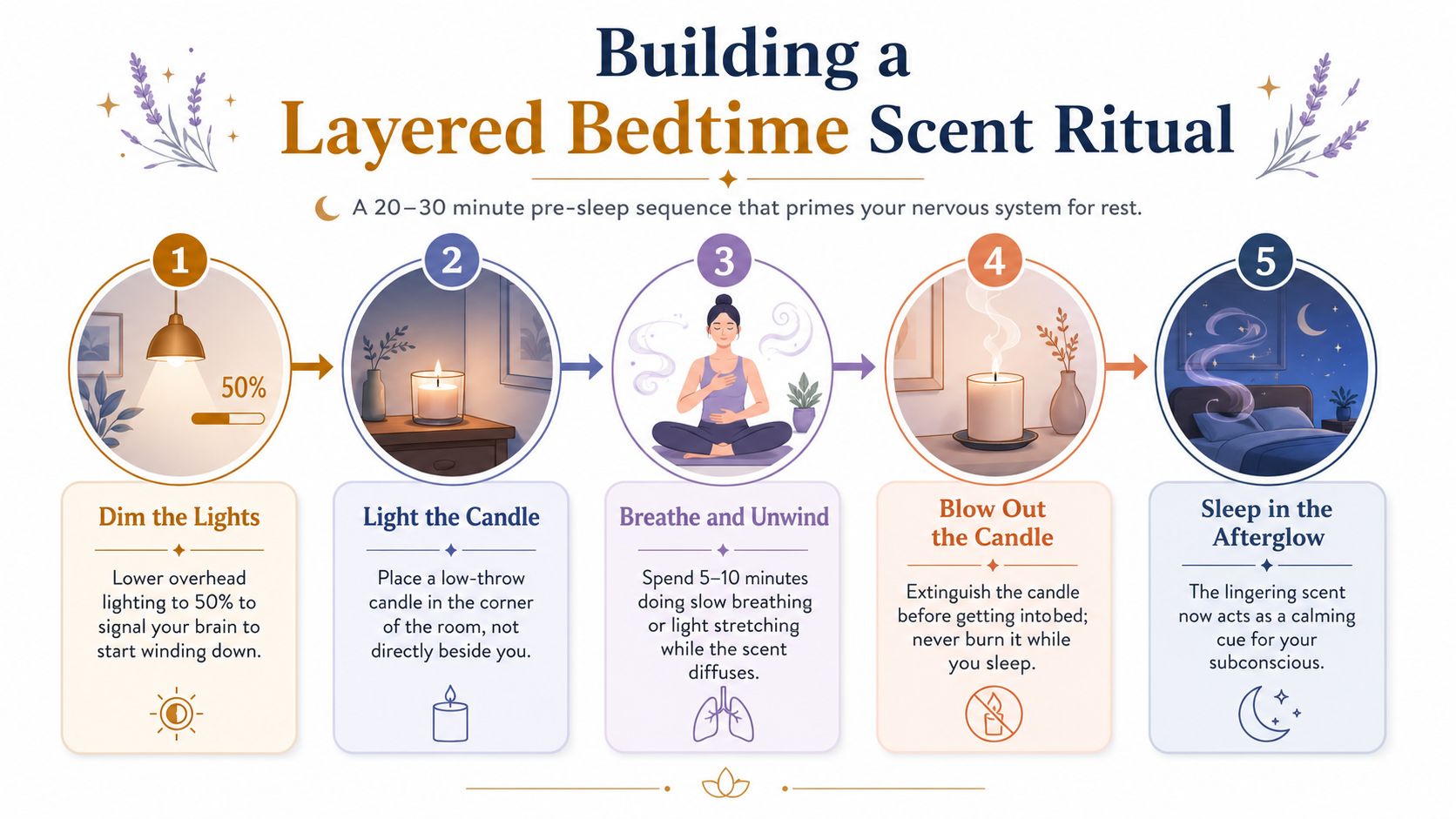
A candle works more reliably when it joins a sequence your body recognizes. Start by dimming overhead lighting roughly 45 minutes before sleep and switch to a warmer bedside source. The change reduces visual stimulation and gives the evening a clear transition, without requiring the candle to carry the entire responsibility for relaxation.
Introduce the candle once the room is darker. Place it in a corner or on a stable surface away from the bed so the fragrance disperses gradually rather than arriving as a concentrated burst beside your face. Spend 5 to 10 minutes breathing slowly, stretching lightly, or reading a few quiet pages while the scent settles.
A comfortable bedroom temperature can support the same transition. Some sleepers prefer a room around 18 degrees Celsius, paired with white noise, a slow playlist, or a caffeine-free tea. These cues don't need to be elaborate. Repetition matters more than creating a perfect spa scene.
Keep fragrance layers restrained
A single-note lavender candle can be enough. If you want more depth, pair it with one softer product, such as a woody or creamy linen spray, rather than adding several competing fragrances. Lavender with a light cedarwood note can feel grounded, while lavender with a soft vanilla note can feel warmer. Your nose should notice a coherent background, not separate products competing for attention.
A useful test: If you're thinking about the fragrance more than you're relaxing, the room has too much scent.
Try this adaptable evening script:
- About 45 minutes before bed: Dim the overhead lights and put your phone away.
- About 20 to 30 minutes before bed: Light a low-throw candle in a safe corner, then open a door or window briefly if the room needs ventilation.
- For 5 to 10 minutes: Stretch, breathe slowly, drink caffeine-free tea, or read.
- Before entering bed: Extinguish the flame and check that no wick is glowing.
- At lights-out: Let the remaining visual and fragrance cues fade naturally.
The candle's job is to mark the transition. It shouldn't remain burning while you sleep, and it shouldn't be strong enough to dominate the room.
Common Sleep Candle Mistakes and Safer Alternatives
A bedroom candle should create a quiet cue, not fill the room with perfume. Strong fragrance often becomes irritating in an enclosed space, especially for people sensitive to fragrance, headaches, asthma, or other respiratory discomfort. Recent candle fragrance trend context also points toward softer, cleaner profiles and growing interest in refillable formats.
First-time buyers often judge a candle by its cold scent in the shop. That test misses the most important bedroom question: how much fragrance reaches the air while the candle burns. Choose a mild or unscented option, and treat scent strength like a lamp's brightness. Enough helps establish the evening cue. Too much keeps demanding attention.
Wax and wick choices matter as well. Look for a clearly labelled wax, a stable heat-resistant vessel, and a wick that does not produce a tall, smoky, or erratic flame. For readers comparing materials, this guide to non-toxic candle wax explains ingredient considerations without treating one material as a sleep treatment.
Refillable sand formats address a different practical problem: cleanup. Let the vessel cool completely, lift out the used wick and hardened material, then wipe away residue before adding fresh sand and a new wick. A reusable holder avoids scraping a deep jar, while measured refills make it easier to use only the amount needed for a short wind-down session. The Candledust offers paraffin-free candle sand in scented and unscented refill formats, with a heat-resistant vessel that can be refreshed rather than discarded.
Be skeptical of labels promising “sleep all night” or an “essential oil cure.” A burning candle belongs in a supervised evening ritual, not beside an unconscious sleeper. Fragrance may feel calming through association, but that experience is a ritual cue, not proof that the candle treats insomnia.
Choose a mild scented or unscented refill, keep the session brief, and use ventilation when the room feels heavy. A sleep-friendly candle provides a sensory cue, a wind-down signal, and controlled ambience, while its wick, wax, and fragrance remain easy to monitor. Explore The Candledust for paraffin-free candle sand, reusable-vessel formats, and fragrance options.