
You're probably here because you've got a candle idea in your head already. Maybe it's a soft citrus kitchen candle, a deep evening scent for the living room, or a wedding table filled with glowing vessels that all need to smell clean, even, and elegant. Then you hit the question that stops almost every beginner.
Should you use fragrance oil or essential oils?
That choice sounds simple until you start making candles. Essential oils sound natural and appealing. Fragrance oils sound stronger and more practical. Then candle sand enters the picture, and the usual advice gets less helpful because loose pearled wax doesn't behave exactly like a poured jar candle.
If you work with candle sand, the scent decision matters even more. Sand wax candles are made from tiny pearled wax beads, specifically small, round pellets of soy-blend wax that look and feel like fine sand, so you pour them into a heat-safe vessel instead of pouring a solid wax block, as explained in this overview of sand candles. That changes how fragrance sits in the material, how it releases, and how consistent the final candle feels.
Table of Contents
- Choosing Your Scent The Great Debate
- What Are Fragrance and Essential Oils
- Performance in Candles A Head-to-Head Comparison
- Decoding Safety and Sustainability
- The Best Scenting Choice for The Candledust Sand
- How to Scent Your Candledust Candles
- Frequently Asked Questions
Choosing Your Scent The Great Debate
You pour candle sand into a glass, place the wick, and add a scent that smells beautiful straight from the bottle. Then you light it and get a surprise. The fragrance in the jar and the fragrance in the flame are not always the same experience.
That gap is why this choice between fragrance oils and essential oils comes up so often in candle-making. New makers often bundle two questions into one. First, what kind of scent source matches your values? Second, what kind of scent source behaves well once heat enters the picture?
Those questions overlap, but they do not always lead to the same answer.
Essential oils attract makers who want plant-based ingredients and familiar scent profiles such as lavender, orange, eucalyptus, or peppermint. Fragrance oils attract makers who want stronger throw, broader scent options, and more consistency from one batch to the next. If you want a helpful outside primer on the broader differences, this guide to aromatherapy oils for retailers gives useful background.
Here is the practical rule. Choose your oil based on what you need the candle to do.
That matters even more with candle sand. Traditional poured wax hardens into one solid body, so scent moves through a single mass of wax. Candle sand behaves more like many tiny wax reservoirs gathered in one container. The oil has to work across loose pearls, around air gaps, and near an exposed flame zone that can change as the candle burns. A scent that seems promising during setup can fade, shift, or throw unevenly once those conditions start to matter.
So the debate is not about which oil sounds better on paper. It is about fit. Your project, your expectations, and your medium should decide the answer.
What Are Fragrance and Essential Oils
Clear definitions save a lot of trial and error, especially with candle sand. Both materials are called “oils,” but they are not the same kind of ingredient, and they do not behave the same once a flame starts warming those loose wax pearls.
Essential oils come from plant material
An essential oil begins with a botanical source such as a peel, flower, leaf, bark, or root. The aromatic material is extracted from that source rather than assembled to match a target scent profile. If you are curious how that difference is explained in a retail setting, this guide to aromatherapy oils for retailers gives useful background.
For a candle maker, the important part is practical. Essential oils carry the character of the plant they came from. That can make them appealing for blends that aim for a natural, herbal, or aromatherapy-inspired feel.
It also means variation is normal. Weather, harvest timing, plant variety, and processing can all shift the final scent. One batch of lavender may smell softer or greener than the last. In candle sand, where scent can release unevenly across many separate wax granules, those subtle differences can become easier to notice.
Fragrance oils are blended to achieve a specific result
Fragrance oils are formulated blends of aroma materials. Some are synthetic, some include naturally derived components, and many are designed with a clear goal such as stronger throw, better heat stability, or a scent that nature does not produce on its own.
A simple comparison helps here. Essential oils work like juice pressed from fruit. Fragrance oils work more like a recipe developed by a flavor house, adjusted until it smells the way the maker wants and performs the way the product needs.
That design control matters in candle projects. A fragrance oil can be built to smell creamy, smoky, marine, sugary, woody, or like a full perfume accord, even if no single plant could produce that aroma alone. If you want more context on candles made with plant-derived scents, our guide to essential oil candles explains that side of the choice in more detail.
Why this distinction matters more in candle sand
In a poured container candle, the wax forms one solid body. In candle sand, the wax stays loose. Scent moves through a bed of small pearls with tiny air spaces between them, and the melt pool develops in a more localized area around the wick.
That setup can magnify the personality of the oil you choose.
Essential oils often smell more botanical and less forceful. Fragrance oils are often more uniform and easier to tune for candle use. Neither option is automatically better. The better option is the one that matches your goal, your tolerance for variation, and the way candle sand releases scent compared with a standard poured wax candle.
The Candledust candle sand format makes that difference easier to observe because you are working with a medium that exposes performance issues quickly. A scent that seems lovely in the jar can behave very differently once only part of the sand near the wick is melting.
Essential oils offer plant character. Fragrance oils offer formula control. That one distinction clears up a lot of confusion for new candle makers.
Performance in Candles A Head-to-Head Comparison
If you care about how a candle smells once the flame is going, the difference becomes practical.
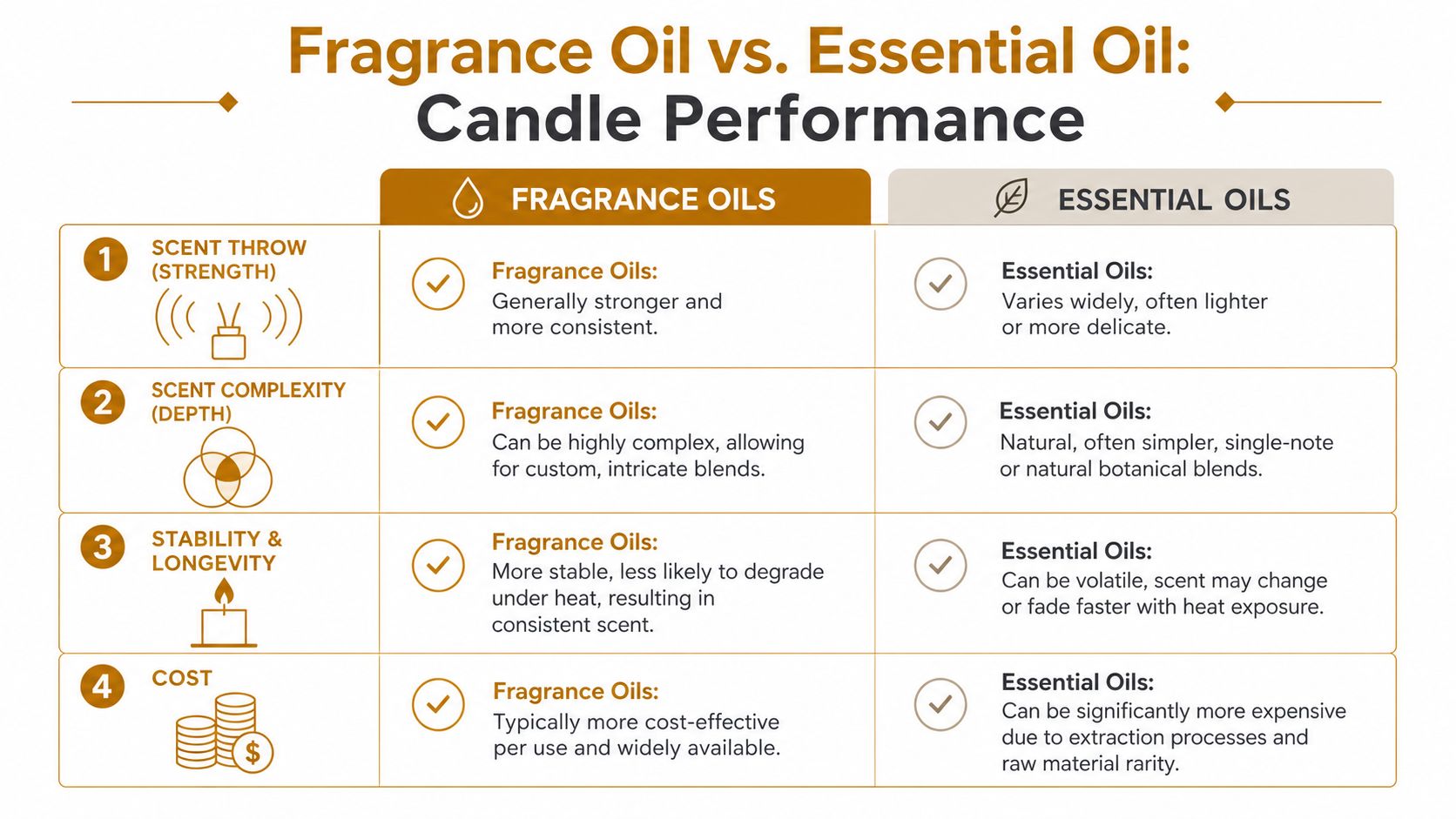
Quick comparison table
| Feature | Fragrance Oils (FO) | Essential Oils (EO) |
|---|---|---|
| Scent throw | Usually stronger and more consistent in candles | Often lighter and less predictable under heat |
| Heat behavior | Engineered for wax solubility and thermal stability | More prone to evaporation or flattening |
| Scent range | Broad, including complex or non-botanical profiles | Limited to natural botanical profiles and blends |
| Batch consistency | More uniform from batch to batch | Can vary based on plant source and processing |
| Compliance workflow | Often simpler for candle-specific documentation | May require more checking for batch consistency and allergens |
| Typical use case | Performance-driven candles, custom scent profiles, repeatable production | Botanical blends, aromatherapy-inspired projects, lighter scent styles |
What matters most while burning
In candle applications, fragrance oils are engineered for wax solubility and heat stability, delivering a hot throw that is 30 to 50% stronger than essential oils, according to this candle comparison from Shivora Candles. The same source notes that fragrance oils maintain tight compositional control, with ±5% deviation in key aroma compounds, which helps keep the scent profile reproducible across production runs.
That sounds technical, but the candle-making takeaway is simple. Fragrance oils are usually better at surviving the conditions inside a candle. They're made to sit in wax, tolerate heat, and continue projecting scent as the melt pool forms.
Essential oils can smell beautiful cold. The problem comes later. Once the flame heats the wax, some essential oil notes can thin out, burn off quickly, or lose complexity.
Here's what that often looks like in practice:
- Cold sniff success, weak burn: The candle smells lovely before lighting, then barely fills the room.
- Sharp opening, flat finish: The first few minutes smell bright, but the scent fades fast.
- Batch surprises: One bottle of oil performs differently from the next.
If you want a more focused look at candle-making with botanically scented wax, this article on essential oil candles adds useful context.
Why beginners often misread cold scent
A lot of people judge a candle by smelling the unlit surface. That's understandable, but it's only part of the story. Candle makers usually care about two things: cold throw and hot throw.
Cold throw is what you smell before lighting. Hot throw is what the candle releases while burning. Fragrance oils often win on hot throw because they're built for that exact job. Essential oils may still work, especially in softer, more intimate scent profiles, but they usually require more experimentation and more realistic expectations.
A candle that smells delicate on purpose can be lovely. A candle that smells faint because the oil can't handle heat is a formulation problem.
Scent complexity also matters. Fragrance oils let you create profiles that don't exist naturally in one plant source. Think warm pastry notes, mineral rain accords, library woods, or sparkling fruit blends with a stable base. Essential oils can make elegant natural blends, but they usually stay closer to herbal, citrus, resinous, floral, and woody families.
For most beginners making candles to scent a room rather than just scent the jar, fragrance oils are easier to work with and easier to repeat.
Decoding Safety and Sustainability
The word “natural” does a lot of heavy lifting in candle conversations. It often makes people assume that essential oils are automatically the safer or more responsible option. Candle making is more nuanced than that.
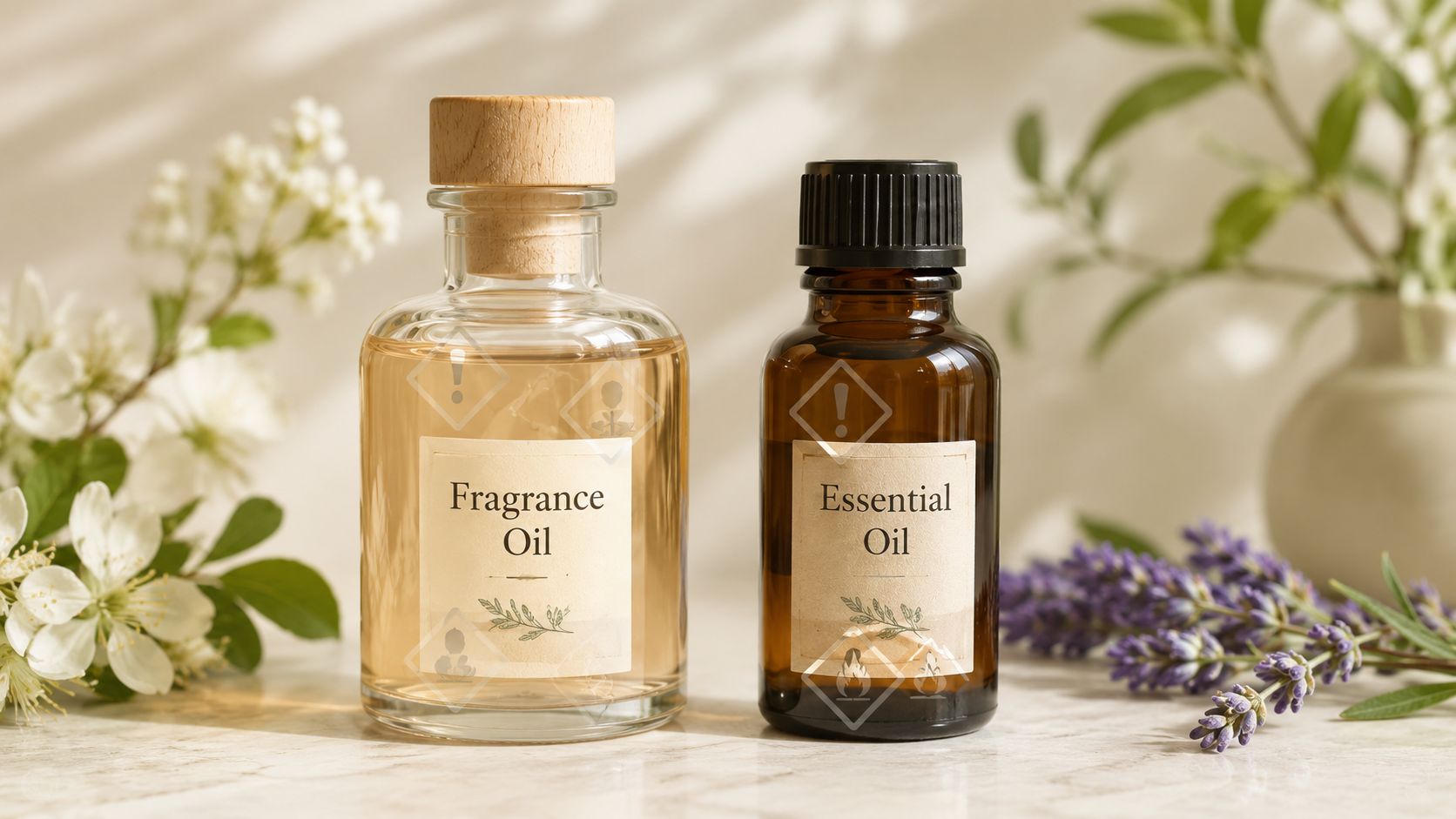
Natural doesn't automatically mean simpler
Both fragrance oils and essential oils need careful handling. Both can contain components that irritate skin or trigger sensitivities. In candles, safety comes from proper formulation, correct usage, and good documentation, not from a marketing label alone.
For EU-compliant candle manufacturing, fragrance oils often offer clearer IFRA pathways and more readily available GC/MS documentation, while essential oils may need extra testing to confirm allergen limits and batch consistency, as noted earlier in the article's performance discussion. That doesn't make essential oils unusable. It means they may ask more of the maker.
If you're thinking about sustainability through the wider lens of material choice, vessel reuse, and reduced waste, this guide to eco-friendly candle-making supplies is worth reading.
Shelf life changes how much waste you create
Fragrance oils exhibit notably longer shelf stability, lasting 2 to 4 years on average, while essential oils typically have a shelf life of about 6 months before noticeable degradation, according to this shelf-life discussion. That longer lifespan is one reason many makers use fragrance oils for products that need consistency over time.
Longer shelf life matters for small businesses and hobbyists alike. If you buy several oils to test blends, shorter-lived materials can leave you with bottles that no longer smell the way they did when you opened them. That can create waste, failed batches, and confusion during testing.
A careful maker should ask different questions than “Is it natural?” Try these instead:
- Will it stay stable in storage?
- Does it have documentation suited to candle use?
- Can I reproduce the same result next month?
- Does this fit the kind of candle I'm making?
Good candle safety starts with informed formulation, not assumptions about what sounds cleaner.
Sustainability also includes whether a material helps you use what you buy well. An oil that stays stable longer and behaves predictably can reduce trial-and-error waste. An oil that degrades quickly can still be useful, but it rewards a tighter workflow and smaller-scale use.
The Best Scenting Choice for The Candledust Sand
You fill a vessel with candle sand, add a wick, and expect it to behave like a poured candle. Then the scent surprises you. One area smells stronger than another, the hot throw feels different from what you tested in a jar candle, and a subtle oil can seem to disappear faster than expected.
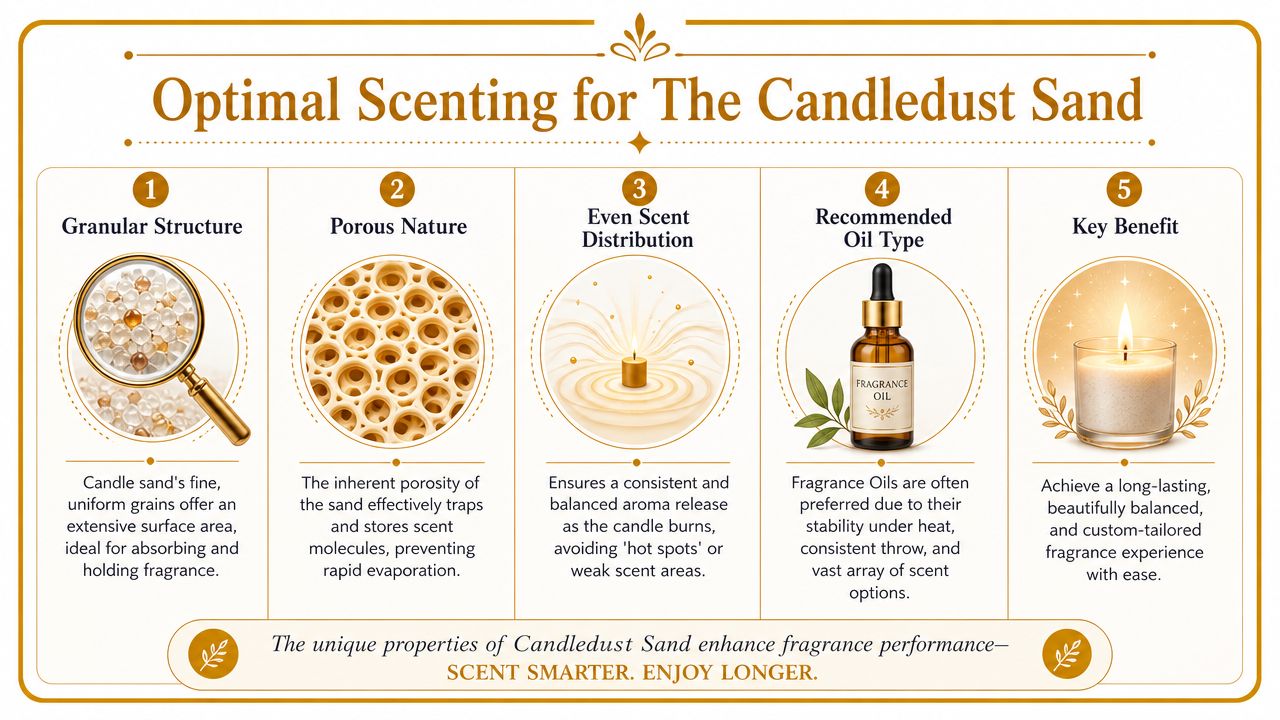
Candle sand changes the usual conversation about fragrance and essential oils because the wax is loose, not poured into one solid block. Each pearl holds and releases scent a little differently, and the burn happens in a small melt pool around the wick instead of across one continuous surface.
That difference matters more than many beginners expect.
Why candle sand changes the discussion
A poured candle behaves like a single sheet of scented wax. Candle sand behaves more like many tiny wax reservoirs sitting side by side. That gives you flexibility in filling and refilling, but it also changes how evenly scent is distributed and how steadily it is released during the burn.
A key unanswered question in DIY communities is how candle sand's porous structure affects scent performance over time. As discussed in this DIY fragrance thread, essential oils are known to evaporate faster under heat, but there is no direct source that answers whether a granular wax format speeds that process up even more.
For a maker, the practical questions are simple:
- Does the oil spread evenly through the pearls?
- Does the scent stay noticeable once the wick creates heat?
- Will the result stay consistent from one refill to the next?
Those questions matter even more in candle sand than in a standard jar candle. If you are still learning the basics of DIY candle making at home, candle sand is a good reminder that the medium shapes the result just as much as the scent itself.
Why fragrance oils usually fit this medium better
In most candle sand projects, fragrance oils are the more dependable option. They are generally designed for candle use, so they tend to hold up better in heated applications and give a clearer, more repeatable scent impression.
Essential oils can still work, but they often ask more from the maker. In a granular wax medium, their softer and more volatile nature can make the result feel quieter or less stable, especially if you want a scent that carries well across a room.
Particle consistency also plays a role here. Smooth, evenly sized candle sand pearls can help scent distribute more uniformly through the vessel, which supports a more predictable burn experience. That does not guarantee identical performance with every oil, but it does reduce one source of variation.
Sand candles are still a less-discussed format than traditional poured candles, so some trial and error is normal. Older scent advice does not always transfer neatly because it was developed for solid wax systems, not loose wax pearls with more exposed surface area.
If your goal is a reliable, room-filling scent in candle sand, fragrance oils are usually the safer technical choice.
Essential oils make more sense when you want a gentler result, a botanical character, or a small experimental batch where subtle throw is acceptable. For stronger scent delivery and fewer surprises in candle sand, fragrance oils are usually the better fit.
How to Scent Your Candledust Candles
Getting the oil type right is only half the job. The other half is adding scent in a way that keeps the candle pleasant, balanced, and practical to burn.
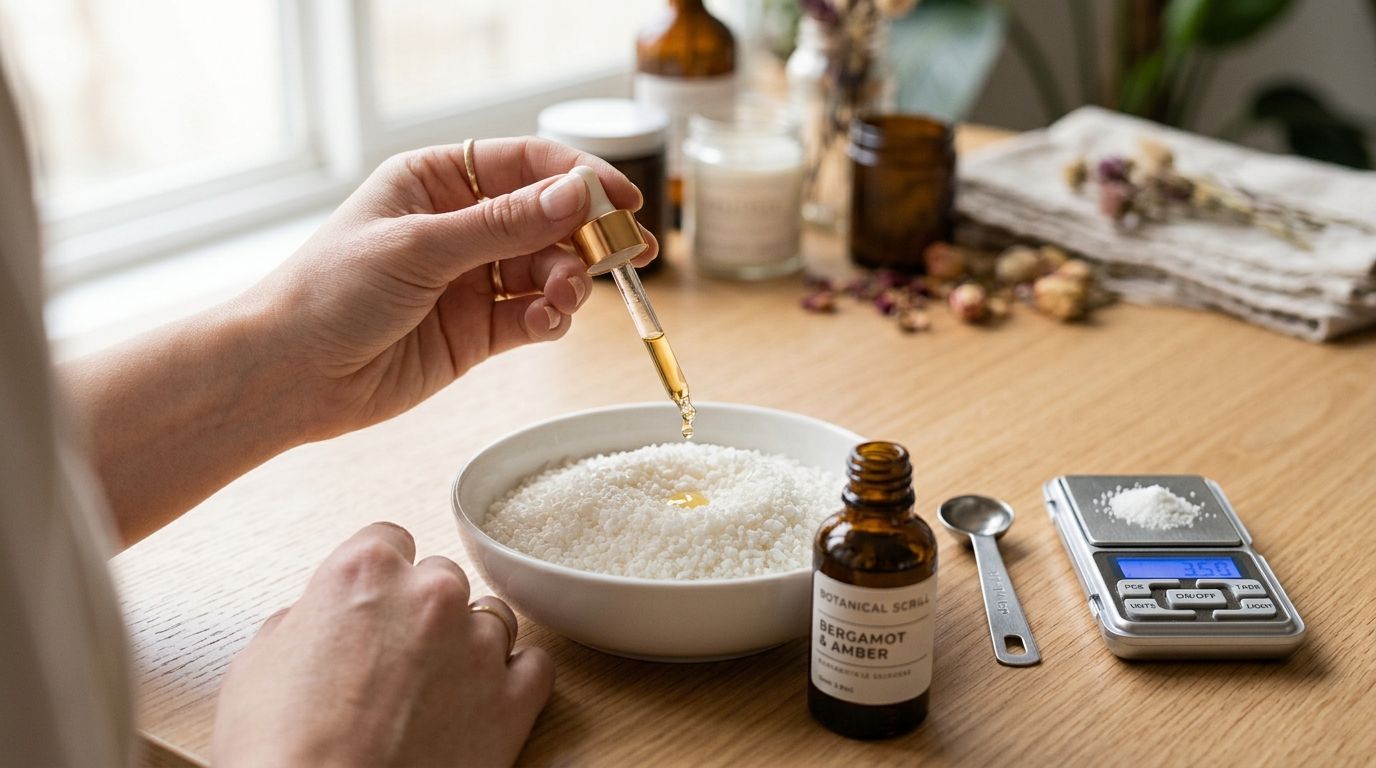
A practical way to add scent
For commercial candle and hospitality use, fragrance oils are optimized for room-filling performance at a 6 to 10% fragrance load in wax, while essential oils often require 12 to 15% loads to achieve comparable throw, according to this home fragrance buying guide. For a beginner, that's a useful starting range rather than a guarantee.
A practical testing approach looks like this:
- Start with a small batch. Don't scent your whole refill at once. Test a small portion first so you can judge both cold and burning scent.
- Use fragrance oil first if performance matters most. In candle sand, that usually gives you the clearest read on what the medium can do.
- Keep essential oil experiments modest. If you want to try them, expect a softer result and watch for fading.
- Label every trial. Write down the oil, the load, the container shape, and your burn impression. Most scent mistakes come from not recording tests.
If you want a broader beginner workflow before scent testing, this guide to DIY candle making at home helps connect the setup steps.
Here's a useful visual walkthrough to pair with your first experiments:
Blend ideas that make sense in sand candles
Loose pearl wax suits both simple and layered scent ideas. I'd start with blends that have a clear structure rather than trying to make ten-note perfume right away.
- Cozy Library: Cedar-forward fragrance oil with soft vanilla and dry paper-like warmth. This style is hard to build convincingly with essential oils alone.
- Coastal Walk: Airy mineral notes, light citrus, and a clean driftwood base. Sand candles often suit fresh, open scents like this.
- Garden Morning: If you want to experiment with essential oils, try a restrained herbal-citrus direction and accept that it may stay softer.
A good beginner mindset is to decide what you want first. Do you want realism, strength, and staying power? Choose fragrance oil. Do you want a gentler botanical mood and don't mind a quieter burn scent? Essential oils can still be worth testing.
Frequently Asked Questions
Can I mix fragrance oils and essential oils in one candle
Yes, you can experiment, but blend carefully. The two materials don't behave identically under heat, so a mixed formula can still perform more like the weaker component. Test small batches and judge the candle while burning, not just unlit.
Why does my essential oil candle smell strong cold but weak when lit
That usually comes down to volatility. Some essential oil components smell vivid at room temperature but fade or flatten once heat builds. The unlit scent can be misleading.
Is fragrance oil always the wrong choice if I want a clean project
No. “Synthetic” doesn't automatically mean careless, and “natural” doesn't automatically mean safer or more effective. The cleaner choice depends on your handling, documentation, storage, and whether the oil suits candle use.
Which one should a beginner choose for candle sand
If you want the easiest path to a reliable scented result, start with fragrance oil. If you enjoy experimentation and are happy with a softer botanical profile, test essential oils in very small batches first.
If you're comparing scent options for refillable pearl candles, The Candledust offers candle sand, wicks, containers, and scent-compatible formats that make it easier to test different vessels and fragrance approaches without committing to a traditional poured candle setup.