

The delivery arrives two days before the reception. The cartons look fine, the quantity is correct, and the candles match the approved color. Then setup begins. Flames drown inside their holders, wax clings to vessel walls, and several cartons contain cracked pieces that can't go on guest tables. The supplier delivered the right count, but not a dependable lighting system.
That is the risk with votive candles in bulk. Buyers often compare pack sizes and nominal burn times while ignoring the variables that determine whether hundreds of candles behave consistently. Wick diameter, vessel geometry, wax chemistry, fragrance loading, transport, storage, and cleanup all affect the true cost.
I've sourced candles for weddings, restaurants, hotels, and large event programs. My recommendation is direct: specify the complete candle system before you negotiate the unit price. For some buyers, that system is a traditional votive and holder. For others, a refillable plant-based candle sand format is the more practical bulk purchase.
Table of Contents
- When a Bulk Votive Order Goes Wrong Before It Even Lights
- What Votive Candles Actually Are and Why They Dominate Bulk Orders
- When Buying Votive Candles in Bulk Actually Pays Off
- Counting the Real Cost of Votive Candles in Bulk
- Wick Sizing, Vessel Diameter, and Wax Chemistry Before You Order
- Sustainability, Plant-Based Materials, and the Sand Refill Format
- Candle Sand as a Bulk Format for Events and Hospitality
- Evaluating Bulk Votive and Candle Sand Suppliers
When a Bulk Votive Order Goes Wrong Before It Even Lights
A wedding planner once ordered 600 standard votives for a 220-guest reception. The candles looked ordinary enough during receiving, but the venue's glass holders had a wider internal diameter than the supplier had tested. On setup night, the flames struggled, wax stayed against the walls, and several wicks became submerged before the ceremony was complete.
Nobody had made one dramatic mistake. The failure came from a chain of small omissions. The planner hadn't received a wick-to-vessel specification, the supplier hadn't tested the actual holders, and the sample approval focused on appearance rather than burn behavior. The same pattern appears in hotel rollouts, corporate galas, and restaurant chains. A candle can be attractive in a product photo and still be wrong for the vessel on your table.
The warning signs buyers miss
Watch for these early failure points:
- Wick mismatch: An undersized wick can tunnel, while an oversized wick may flicker, soot, or overheat.
- Unverified fragrance loading: A supplier that won't disclose the wax and fragrance specification can't give you reliable burn expectations.
- Weak packaging: Pre-cracked wax, crushed cartons, and loose holders create waste before installation.
- Unmatched samples: A test candle in one vessel tells you little about performance in another.
Independent wick guidance recommends starting small votives around 1.25 to 2.0 inches with ECO-1 to ECO-2, while 2.0 to 2.5 inch vessels may move to ECO-4. The wick must create a melt pool that reaches the vessel wall within about 2 to 4 hours. Those recommendations are tied to diameter, not marketing language, so buyers should review the wicking guidance for container candles before approving a production run.
The procurement process that prevents repeat failures
Ask for a complete spec sheet before requesting a large sample. It should identify the wax type, vessel dimensions, wick series, fragrance load, recommended holder, packaging method, and expected burn behavior. Then test candles in the exact holder, with the exact fragrance and placement conditions planned for the event.
Procurement rule: Never approve bulk votives from a photograph or a single loose sample. Approve the candle, holder, packaging, and burn test as one system.
For planners reviewing delivery options, candles with free delivery can also be part of the landed-cost comparison. Freight, breakage, and replacement time belong in the purchase decision. The rest of this guide focuses on those practical failure points, not just the number printed on the carton.
What Votive Candles Actually Are and Why They Dominate Bulk Orders
A votive candle is a short cylindrical candle designed to burn inside a holder. In operational terms, the familiar format is roughly 2 inches tall and 1.5 to 2 inches in diameter, with a typical stated burn window of 10 to 15 hours. Those dimensions and burn figures are summarized in the accompanying votive candle dimensions and bulk ordering infographic.
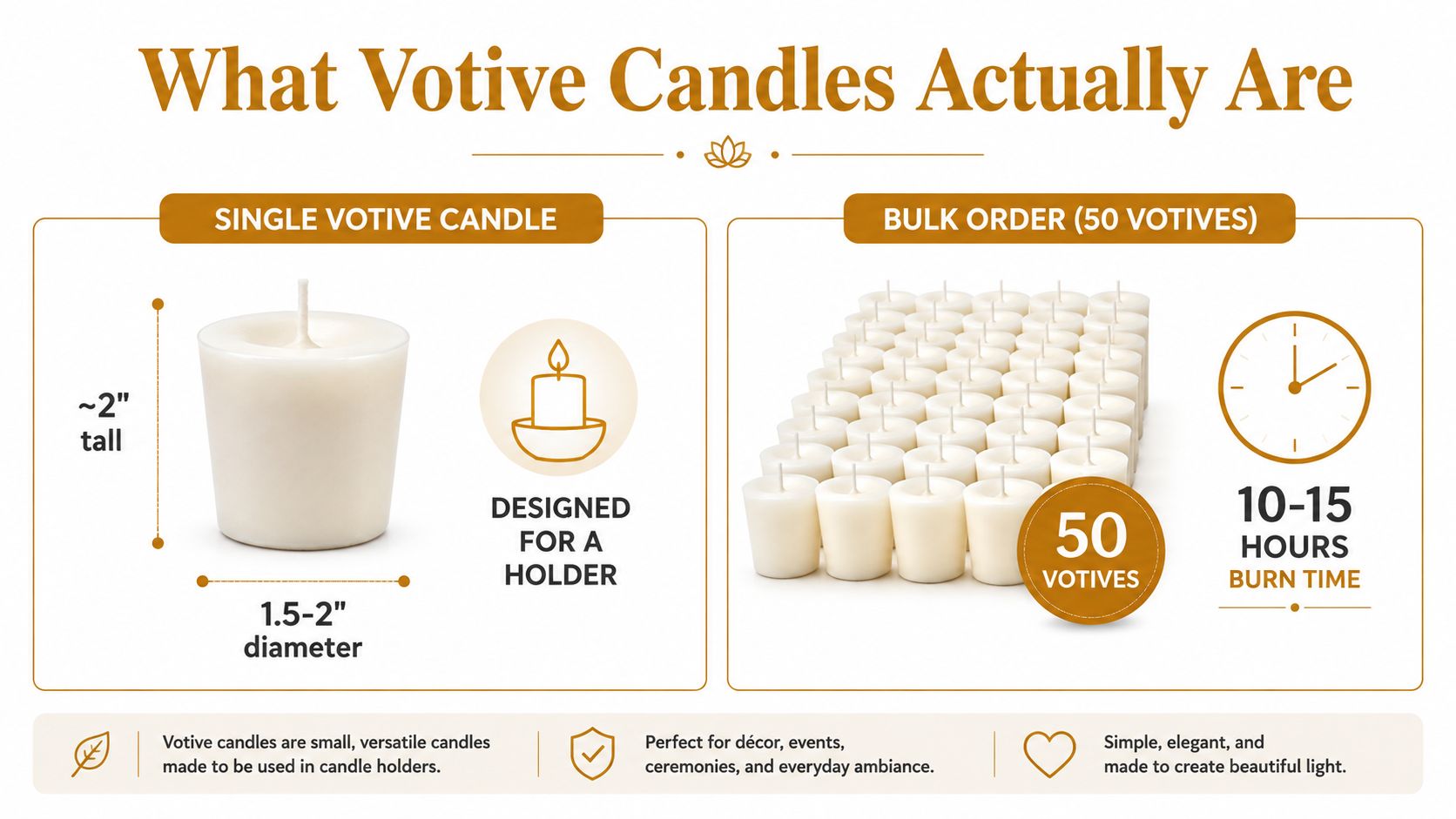
The holder isn't optional. Votives liquefy as they burn, so using one without a suitable votive holder can make the wax spread flat rather than produce the intended burn. That practical warning is documented by 100 Candles' bulk votive guidance, and it matters more than a nominal burn-time claim because holder fit directly affects performance.
Votives compared with other candle formats
Tealights are smaller and usually arrive in disposable metal or plastic cups. They suit short-duration table settings and quick replacement, but they offer less visual mass. Pillars are freestanding and larger, so they don't require the same type of holder, but they take up more space and create a different display.
Votives became the standard bulk format because they combine:
- Uniform presentation: Identical cylinders create a consistent look across tables.
- Holder compatibility: Standard glass and ceramic holders make placement simple.
- Manageable replacement: Staff can replace individual units without rebuilding an arrangement.
- Predictable planning: A defined burn window supports event schedules and service routines.
Material choices affect the buying decision
Bulk votives may use paraffin, soy blends, coconut wax, or palm wax. Paraffin remains common because it generally supports cost-sensitive production and strong scent performance. Soy formulas can require different wick behavior and may burn longer because their lower melt behavior slows consumption, according to the fragrance-load and soy wax guide.
The format stops being the right answer when the holder, waste stream, refill routine, or storage environment creates more work than the candle solves. That is where reusable sand formats deserve a serious comparison.
When Buying Votive Candles in Bulk Actually Pays Off
Bulk purchasing pays when consumption is repeatable. A hotel that lights the same style of table every evening has a different buying profile from a planner who runs occasional weddings with changing color palettes and scent requests.
Start with four questions:
- How many candles do you consume over a normal operating year?
- Will the same color, fragrance, and vessel remain in use?
- Can you store cartons in a stable, dry, temperature-controlled area?
- What does a shortage cost during a live event or service period?
Storage deserves more attention than it gets. Wax and fragrance can soften, shift, or become less stable in heat, and cartons can suffer under poor stacking. Don't buy a large case just because the per-unit quote looks attractive. Buy it when the product will move through your operation before quality, design, or procurement requirements change.
A practical break-even framework
Record annual consumption, then request comparable quotes at pack levels such as 100, 500, 1,000, and 2,000 or more units. Compare the full delivered cost, not only the candle price. Include holders, freight, breakage, replacement units, storage, and the labor required to sort and prepare candles.
Use the table as a decision filter rather than a universal rule. The thresholds are operational recommendations, not market statistics.
| Buyer Type | Annual Volume Threshold | Break-Even Pack Size | Bulk Risk Level |
|---|---|---|---|
| Hotel or restaurant with recurring service | High, repeat consumption | Large case or scheduled replenishment | Low when format stays fixed |
| Large venue with frequent events | High, predictable programs | Multi-case order after burn testing | Moderate |
| Wedding planner with occasional bookings | Variable, design-led demand | Smaller case or event-specific order | High |
| Boutique event studio | Variable, premium customization | Small case with flexible reordering | High |
| DIY buyer | Limited, irregular use | Pre-packed small case | Very high for wholesale volume |
Bulk buying backfires when scent profiles are still being tested, color schemes change frequently, or the buyer has no stable storage. It also fails when a warehouse pallet looks inexpensive but will sit untouched through multiple seasons.
Buying principle: Repetition justifies volume. Uncertainty doesn't.
The right bulk order is unambiguous when the same candle will be used repeatedly, the holder has been tested, the storage area is suitable, and the supplier can replenish on a schedule that matches consumption.
Counting the Real Cost of Votive Candles in Bulk
The cheapest candle isn't automatically the cheapest event. A realistic cost model has three layers: the candle, the vessel, and the operating work surrounding both.
The first layer is the candle itself, often sold in packs ranging from 50 to 200 pieces. The second is the holder, which may be glass, ceramic, or another heat-resistant vessel. The third includes receiving, sorting, placement, post-event collection, wax residue, breakage, disposal, and freight on heavy cartons.
A $0.45 candle that tunnels and leaves wax in the holder can cost more in labor and replacement than a $0.70 candle that burns cleanly. Those example prices illustrate the principle only. They aren't a supplier quote or a market benchmark.
Compare the complete system
Traditional votives usually require a fresh candle for each burn cycle. Candle sand changes the replacement model because the buyer can refill the same suitable vessel, replace the wick, and avoid discarding a complete candle body after every use. The mechanics of plant-based granules, including their loose format and use in heat-safe vessels, are described in The Candledust's candle calculator and related product guidance.
| Format | Pack Size | Per-Unit Cost (USD) | Avg Burn Hours | Cost Per Burn Hour | Reusable Vessel Required | Estimated Cost Per 5 Events |
|---|---|---|---|---|---|---|
| Traditional votive | 50 to 200 pieces | Supplier quote required | Supplier specification required | Calculate from delivered cost | Usually a holder | Add five event cycles and replacement rate |
| Candle sand refill | Refill pack or bulk format | Supplier quote required | Test for vessel and wick | Calculate from refill consumption | Yes | Refill cost plus vessel and wick replacement |
| Tealight | Multi-pack | Supplier quote required | Supplier specification required | Calculate from delivered cost | Usually built into unit | Add five event cycles and disposal |
| Pillar | Individual or case | Supplier quote required | Supplier specification required | Calculate from delivered cost | Not always | Add replacement and storage costs |
For each option, use this formula: delivered format cost divided by verified burning hours. Then add the labor cost of preparing, replacing, collecting, and cleaning the candle system. A sand refill can become more economical after repeated vessel use, but only if staff can refill efficiently and the container is rated for the heat.
Don't hide cleanup in a general event budget. That is where low-priced candles often lose.
Wick Sizing, Vessel Diameter, and Wax Chemistry Before You Order
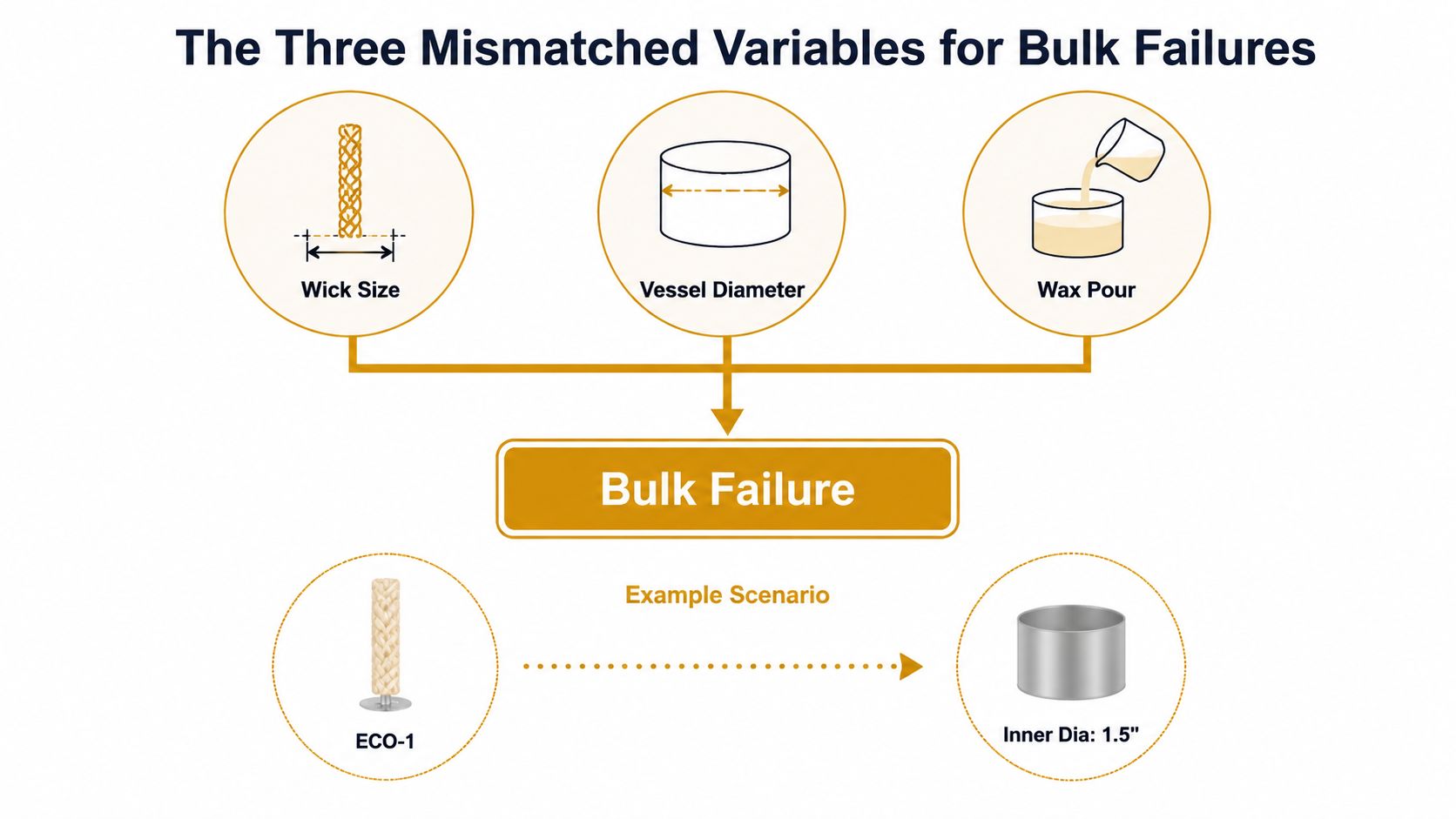
Bulk candle failures usually start before the first flame. Wick size, vessel diameter, and wax chemistry must be approved as one system. A buyer who signs off on color and fragrance alone has not approved the burn performance.
For small votive vessels around 1.25 to 2.0 inches, use ECO-1 to ECO-2 as starting points. Vessels around 2.0 to 2.5 inches may require ECO-4. The target is a melt pool that reaches the container wall within approximately 2 to 4 hours, following the container candle wicking guide.
Test the variables together
An undersized wick leaves wax along the walls and causes tunneling. An oversized wick can create flicker, soot, excess heat, or an unstable flame. Switching from paraffin to soy changes the wick requirement too, because soy commonly needs a larger wick to form a complete melt pool.
Fragrance changes the burn as well. Soy formulas commonly use 8% to 10% fragrance load, with 10% described as a typical upper safe load for widely used soy blends. Fragrance is usually added at 180°F to 185°F, or 82°C to 85°C, to support binding and reduce separation, according to soy wax fragrance-load guidance.
Before issuing a purchase order, request:
- The vessel's internal diameter, not only its outside measurement.
- The exact wick series and size used in production.
- The wax type and melt behavior of the approved formula.
- The fragrance percentage and mixing temperature for scented versions.
- A burn test in the final holder, never a substitute container.
For sand refills, Extra wicks 6cm (1000pcs) are another pack option. The linked catalog item describes each additional wick as 5 cm long without a sustainer. Use that specification when planning refill quantities, and do not approve a different length without testing it in the final vessel.
Test standard: Approve the flame, melt pool, soot level, and holder temperature before approving the quantity.
Sustainability, Plant-Based Materials, and the Sand Refill Format
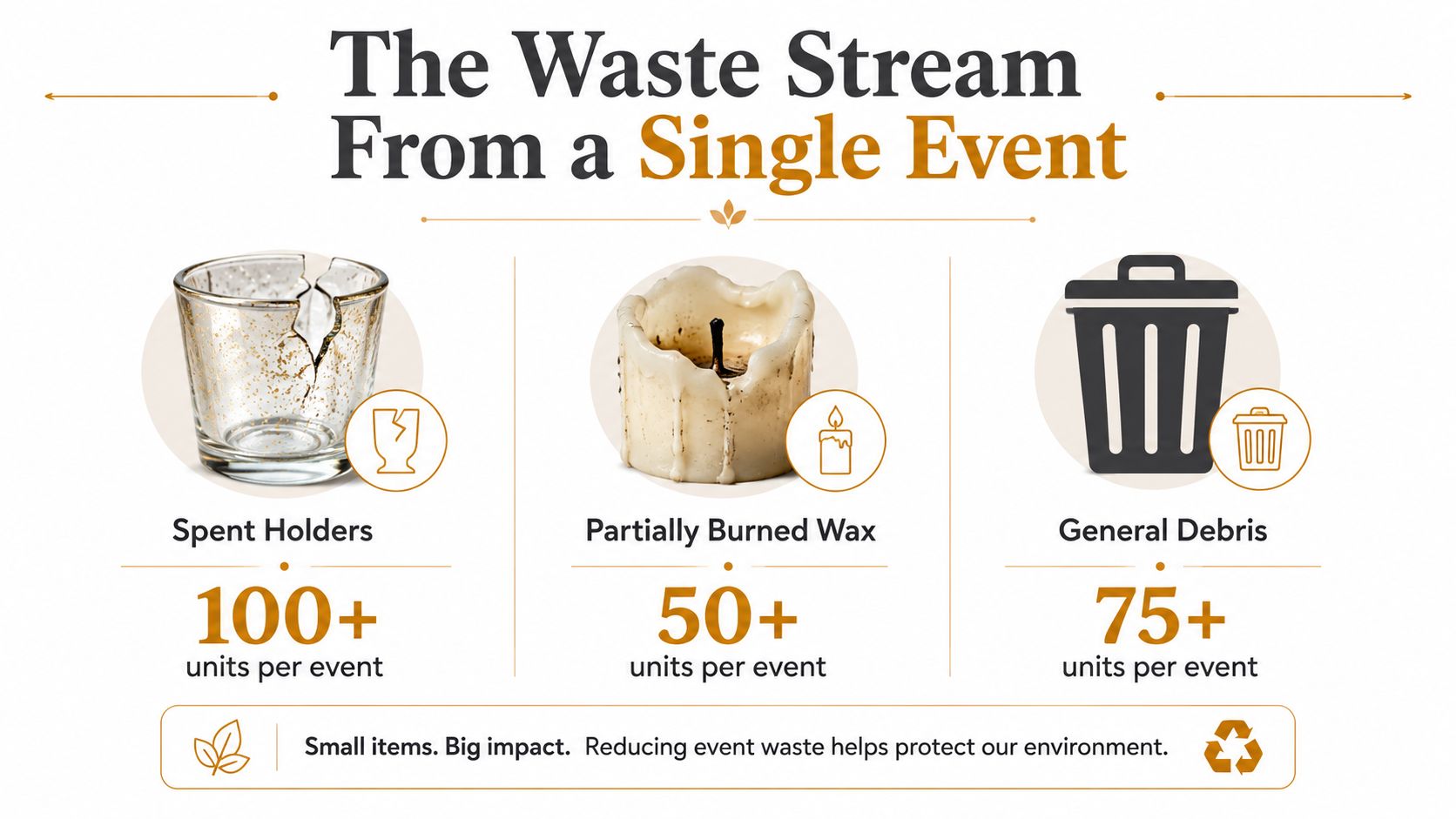
Sustainability becomes useful when it reduces what staff must throw away and handle. Traditional bulk votives can leave spent holders, partially burned wax, and packaging debris after an event. A refillable sand system uses a heat-resistant vessel repeatedly, so the buyer replaces the consumable wax and wick rather than the whole candle unit.
Candle sand is a real product category made from plant-based wax granules poured into a heat-resistant container and lit with a separate wick. Commercial vegetable-based waxes, including soy and palm wax, were developed for candle use in the late 1990s, so plant-based candle materials aren't experimental. The format and material background are explained in what candle sand is.
Reuse changes the labor calculation
Fine loose granules pour into a suitable vessel, accept fragrance oils and dyes, and can be stored as a dry material. One supplier specifies a melting point of 131°F / 55°C for its sand wax and describes compatibility with fragrance oils and dyes in its sand wax product specification.
For a venue, the value comes from repeatability. Staff can keep approved vessels, refill them between bookings, and avoid scraping every container after a short burn. For planners, reusable centerpieces can serve multiple designs, though the vessel still needs inspection and a wick replacement routine.
Material questions should be specific:
- Origin: What plant-based waxes are used?
- Documentation: Are material and safety records available?
- Vessel rating: Is the container designed for repeated candle use?
- Operations: Can staff refill without contaminating the sand or fragrance?
- Disposal: What remains after burning, and how must it be handled?
For practical ideas on greener corporate gatherings in New Zealand, connect the candle decision to the wider event waste plan. A refill system only earns its sustainability advantage when the venue reuses the vessels.
Candle Sand as a Bulk Format for Events and Hospitality
Candle sand should be evaluated as a procurement format, not a decorative novelty. The material consists of fine, loose wax granules that are poured into a heat-resistant vessel, followed by a separate wick. The buyer controls the fill depth, vessel choice, color presentation, and refill process.
A standard workflow is straightforward:
- Select and inspect the vessel. Confirm that it is heat-resistant, stable, and suitable for the planned display.
- Pour the granules evenly. Avoid contaminating the material with dust, water, or debris.
- Insert the wick securely. Keep it centered and upright.
- Run a controlled burn test. Check flame behavior, melt pooling, smoke, and vessel temperature.
- Replace the wick after use. Reuse remaining material when the product instructions support it.
The format can simplify staging because dry granules don't create the same melt-damage concern as a finished wax candle during warm-weather transport. It also lets a team prepare vessels close to the event without lighting them in advance. Those advantages matter for outdoor ceremonies, brand activations, scent-free tables, and venues that change layouts frequently.
Where sand wins and where it doesn't
Candle sand works well when the buyer wants:
- Reusable vessels across multiple events.
- Flexible colors or fragrances for changing concepts.
- Less finished-candle packaging in storage.
- Refill logistics rather than constant replacement.
- A controlled, clean presentation in approved containers.
Traditional votives still make more sense when the venue has an established holder system, a fixed replacement schedule, and no staff capacity for refilling. Sand also isn't the right tool for a single long-burn unity candle or a table with no clearance for handling refills.
The Candledust's candle sand and pearled candle comparison is useful when a buyer is deciding between loose refill material and a formed decorative candle. The correct choice depends on whether the priority is rapid replacement, reusable presentation, or a single finished centerpiece.
Evaluating Bulk Votive and Candle Sand Suppliers
Supplier vetting should produce documents, samples, and clear reorder terms. A persuasive sales call isn't proof of manufacturing control. For scented candles and wax blends sold in major markets, buyers also need to understand compliance responsibilities. EU guidance states that candles fall under REACH Regulation 1907/2006 and CLP Regulation 1272/2008, as explained by EU candle compliance guidance.
Start with the document pack
Request the following before discussing a large private-label or hospitality order:
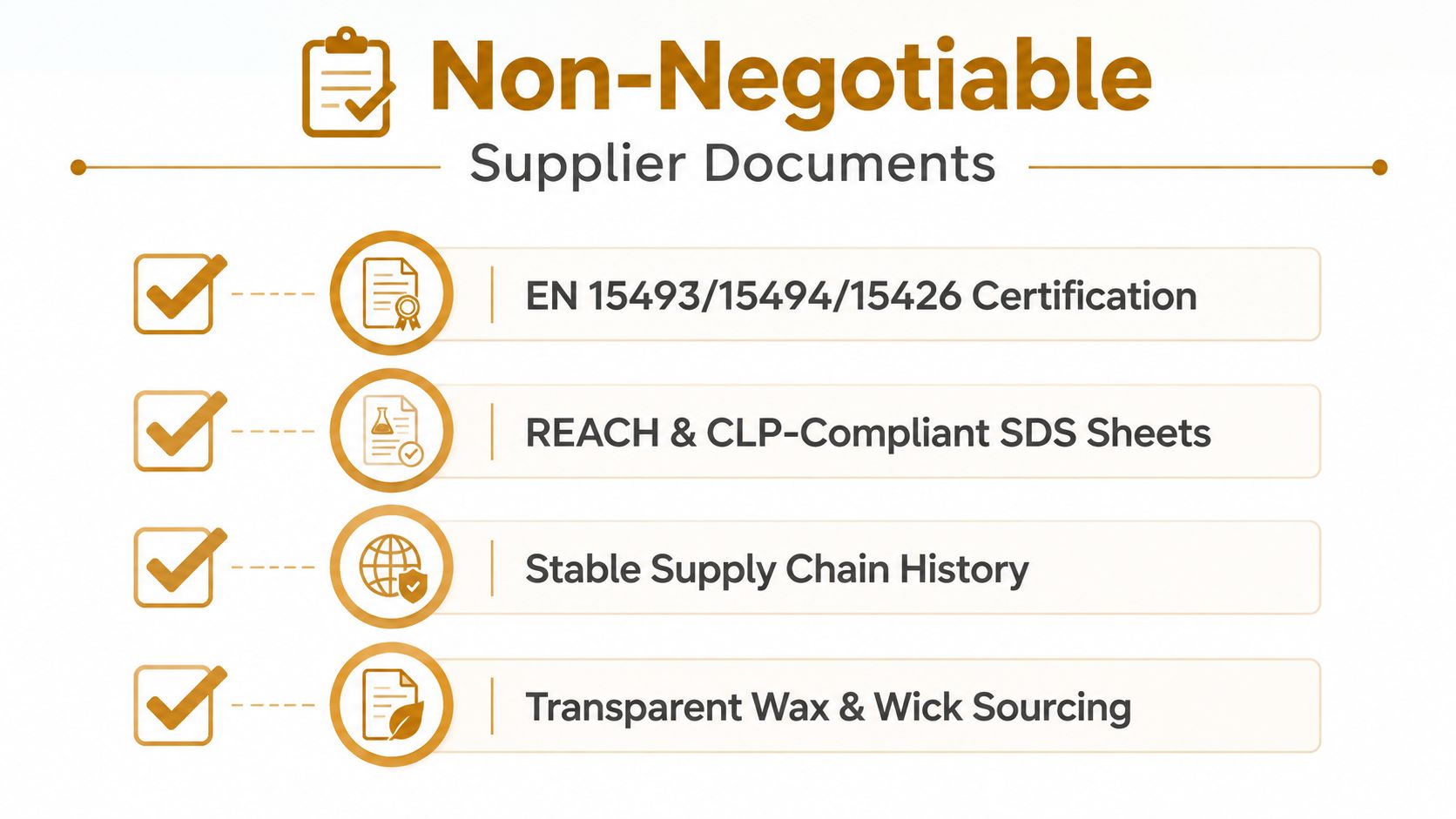
- EN 15493, EN 15494, and EN 15426 documentation: Ask what each document covers and whether it applies to the exact product.
- REACH and CLP-compliant SDS sheets: Scented products need clear safety and labeling information.
- Stable supply-chain history: Request evidence of consistent sourcing and batch control.
- Transparent wax and wick sourcing: The supplier should identify the formula and wick system used in samples.
The required image below summarizes this document-first approach.
Don't accept “hand-poured” as a substitute for tolerance control. Hand production can be excellent, but batch-to-batch variation still needs a defined acceptance standard. Ask the supplier to state its permitted burn variance, wick-centering tolerance, fragrance-load ceiling, and packaging protection for stacked transport.
Challenge the commercial terms
The quoted minimum order quantity may not be the true minimum after freight, setup fees, custom labels, and packaging charges. Ask whether white-label pricing includes artwork, whether private-label cartons are produced locally or shipped separately, and whether drop shipping is available for planners who don't want to warehouse event stock.
For a pre-shipment run, request 50 to 100 units before committing to a 5,000-unit order. Test several cartons, not only the first sample. Check wick centering, color consistency, scent strength, vessel fit, cracked wax, carton compression, and burn behavior. Confirm lead times for both EU and US rollouts, then ask what happens during peak season.
Match the format to the buyer
Wedding and event planners running 10 or more ceremonies in a season should favor candle sand refills with reusable glass when their designs and vessels can remain flexible. The supplier must document burn behavior and support predictable replenishment.
Hotels and restaurants with a 12-month replacement cadence should choose bulk unscented paraffin or coconut-wax votives when the holder program is fixed. Require EN documentation and scheduled quarterly drops rather than relying on emergency orders.
Churches and memorial buyers need long-burn, low-soot votives with stable supply contracts. Consistency matters more than a rotating fragrance collection.
DIY and retail buyers under 200 units should skip wholesale minimums and purchase pre-packed cases. A lower commitment protects cash, storage space, and design flexibility.
Before signing a purchase order, ask every supplier these three questions:
- What documented burn variance should we expect?
- What is the MOQ at our true recurring volume?
- What does reorder lead time look like during peak season?
Supplier test: If the answer changes after you ask about documentation, samples, and reorders, choose a different supplier.
The Candledust focuses on plant-based candle sand, reusable vessels, scented and unscented refill formats, and bulk options for events and hospitality. If your operation is ready to compare a refill system against conventional votive cases, visit The Candledust with your vessel dimensions, expected usage, and delivery schedule prepared. Ask for a format recommendation based on the way your team burns, replaces, and stores candles.