
You're standing in a shop with two candles in your hands. One lists its wax, wick, fragrance information, and container materials. The other promises a “clean burn” and “natural scent,” but leaves you guessing what those phrases mean. You're not only deciding which aroma you prefer. You're wondering whether the candle might aggravate sensitivities, create soot, fit the vessel you already own, or leave you paying for a formula you can't evaluate.
That uncertainty is the problem ingredient transparency solves. A useful candle label connects each material choice to a practical result, including wick performance, scent throw, vessel compatibility, burn behavior, and waste reduction. This guide explains how to read those choices, where disclosure has limits, and how a sand-candle format can make the formulation easier to inspect.
Table of Contents
- Why Candle Shoppers Are Reading Labels More Carefully
- What Ingredient Transparency Actually Means in a Candle
- Why Transparency Matters for Health, Sustainability, and Trust
- How to Read a Candle Label and What to Ask the Brand
- Regulations, Allergen Disclosure, and Certifications Explained
- Consumer Questions Versus B2B Transparency Needs
- How The Candledust Builds Transparency Into Every Pearl
- A Short Transparency Checklist You Can Use Today
Why Candle Shoppers Are Reading Labels More Carefully
A label that says “paraffin-free” may answer one question, but it doesn't tell you whether the wick is cotton or wood, whether the fragrance is an essential oil or a complex blend, or whether the vessel can be reused. “Clean” sounds reassuring, yet it doesn't describe the recipe. The shopper holding those two candles is looking for information that helps predict the experience after purchase.
That expectation has spread beyond specialist buyers. A 2018 multi-market study found that 86% of consumers globally considered ingredient transparency extremely or very important, with the figure reaching 88% in emerging markets and 84% in developed markets. The same research found that 93% of shoppers considered detailed information about what food contains and how it's made important, a useful signal that transparency is closely tied to trust across product categories. The study's findings on ingredient transparency and brand trust help explain why candle buyers increasingly want more than broad marketing language.
From label interest to purchase decisions
Consumers don't just notice transparency, they use it. A 2023 FMI report found that 76% of surveyed grocery shoppers considered transparency about ingredients and how food is made important, up from 72% in 2022 and 69% in 2018. Earlier research cited in the same reporting found that 58% of shoppers read labels all or most of the time before buying a new item, while 35% said confusing ingredients would stop them from buying a product. The FMI reporting on transparency and shopping behavior shows why clear explanations can influence comparison, conversion, and brand switching.
For candles, the equivalent questions are straightforward. What is the wax? What holds the flame? What creates the fragrance? Which additives affect appearance or stability? Once a brand answers those questions in plain language, the label becomes a bridge between formulation and lived experience.
What Ingredient Transparency Actually Means in a Candle
Think of a candle as a short, burnable recipe. A bread label doesn't stop at “grain-based loaf,” because the type of flour, oil, salt, and added ingredients affect the result. Candle ingredient transparency works the same way. The brand should identify the materials that shape how the candle burns, smells, looks, and fits into a user's home.
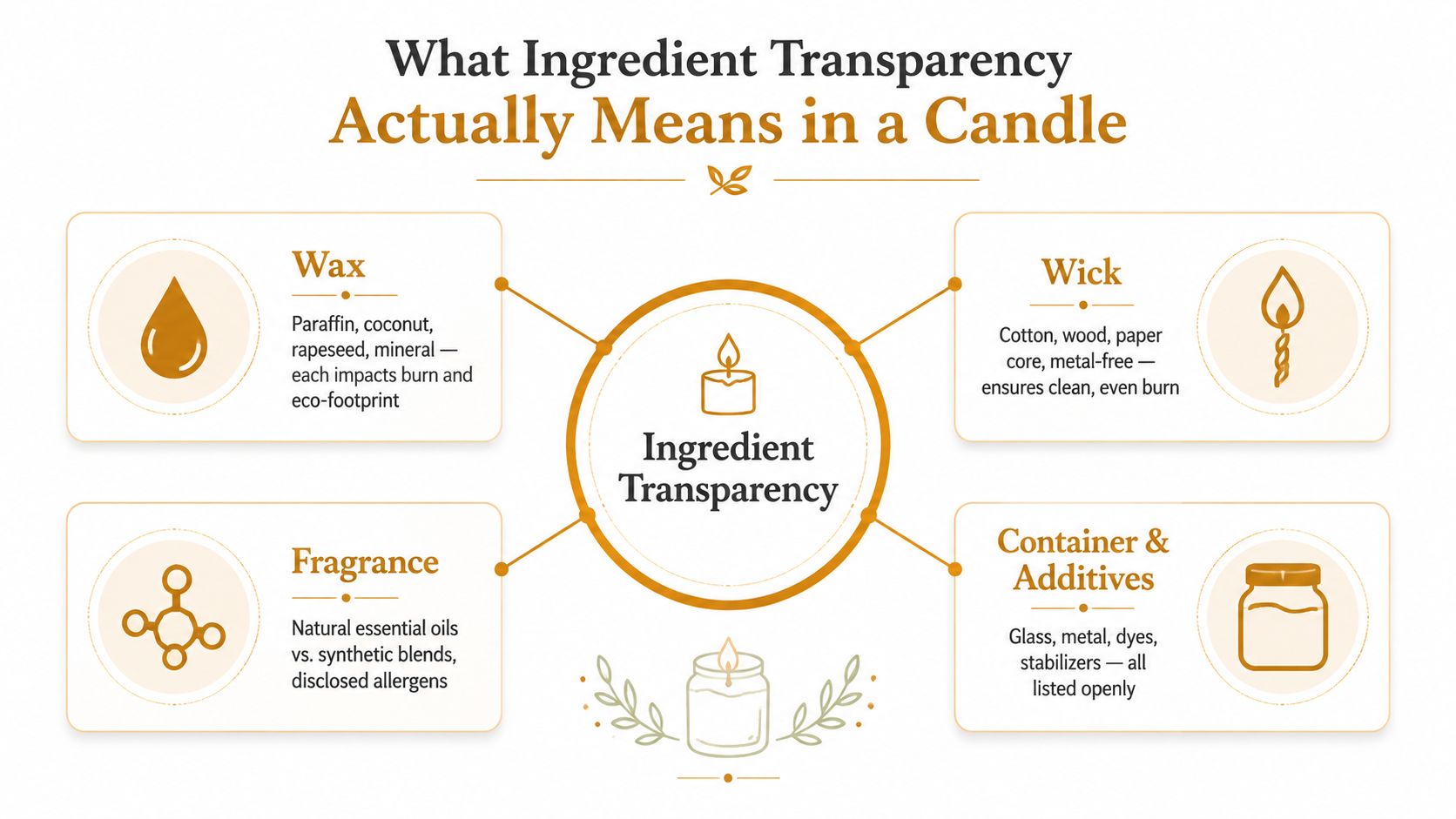
Start with the four formulation pillars
Wax is the fuel and the structure. A formula may use paraffin, coconut, rapeseed, mineral wax, or a blend. The blend affects melting behavior, firmness, appearance, fragrance retention, and compatibility with the vessel. “Plant-based” is a useful starting point, but it still leaves an important question unanswered: which plant waxes, and in what proportions?
The wick controls how fuel reaches the flame. Cotton, wood, paper-core, and metal-free constructions can behave differently in terms of flame height, sound, stability, and melt-pool formation. A transparent maker identifies the wick material and, where relevant, explains how it was selected for the candle format.
Fragrance needs more than a scent name. A product may use a single-note essential oil, a fragrance oil designed for candle use, or a blend containing multiple aromatic materials and carriers. A label that says only “fragrance” gives the customer limited visibility, so the brand should provide relevant safety and allergen information through its product page or documentation.
Additives and the container complete the recipe. Dyes, pigments, UV stabilisers, hardening agents, and other formulation aids can change color, shelf stability, or handling. The vessel also matters. Glass, aluminium, ceramic, and other materials affect heat resistance, reuse, recycling, and disposal.
True transparency therefore means naming the wax type, wick material, fragrance status, known allergens where disclosure applies, additives, and container composition. It doesn't require a technical chemistry lecture. It requires enough detail for a buyer to understand what each input does and why it's there.
Why Transparency Matters for Health, Sustainability, and Trust
Ingredient transparency matters for different reasons, and those reasons can lead to different buying decisions. Someone with fragrance sensitivities may focus on allergens and fragrance disclosure. A sustainability-minded buyer may care more about wax sourcing, vessel reuse, and refill design. Another shopper may want evidence that a brand's claims are specific rather than decorative.
Health questions deserve careful language. Buyers often ask about paraffin-derived materials, fragrance allergens, phthalates, and soot. Some concerns relate to recognized labeling or safety requirements, while others are amplified by vague “non-toxic” marketing that treats every synthetic ingredient as automatically dangerous. A transparent brand should distinguish a material's identity, its intended use, and the conditions that affect candle performance, such as wick trimming and correct burning.
For a broader discussion of wax choices, see this guide to non-toxic candle wax. The useful takeaway is simple: a material name alone doesn't explain the whole risk or performance picture.
Three motivations behind candle ingredient transparency
| Motivation | Specific concern | Buying behaviour change |
|---|---|---|
| Health and sensitivity | Fragrance allergens, unclear formula language, soot, or poorly explained materials | The buyer looks for ingredient details, safety information, and clear burning guidance |
| Sustainability | Wax sourcing, disposable vessels, refill potential, and material waste | The buyer compares the full use cycle, not only the front-label claim |
| Trust | A gap between words such as “natural” or “clean” and the actual recipe | The buyer favors brands that answer questions directly and may change brands when information is missing |
Sustainability also requires more than a plant-based wax claim. A candle can use renewable inputs and still create unnecessary waste if the vessel is difficult to reuse or the remaining wax can't be recovered. A refillable format changes that calculation because the container can serve as part of a longer candle system.
Trust grows when the brand explains tradeoffs instead of pretending every choice is perfect. A fragrance blend may offer a more consistent scent profile than a single essential oil. A harder wax may improve stability in a particular vessel. Transparency lets the customer understand those decisions and choose according to personal priorities.
How to Read a Candle Label and What to Ask the Brand
Start at the back panel, not the front. The front is designed to communicate mood and identity, while the back or product page is more likely to reveal the materials, warnings, origin, and use instructions that help you assess the candle.
Use a repeatable inspection routine
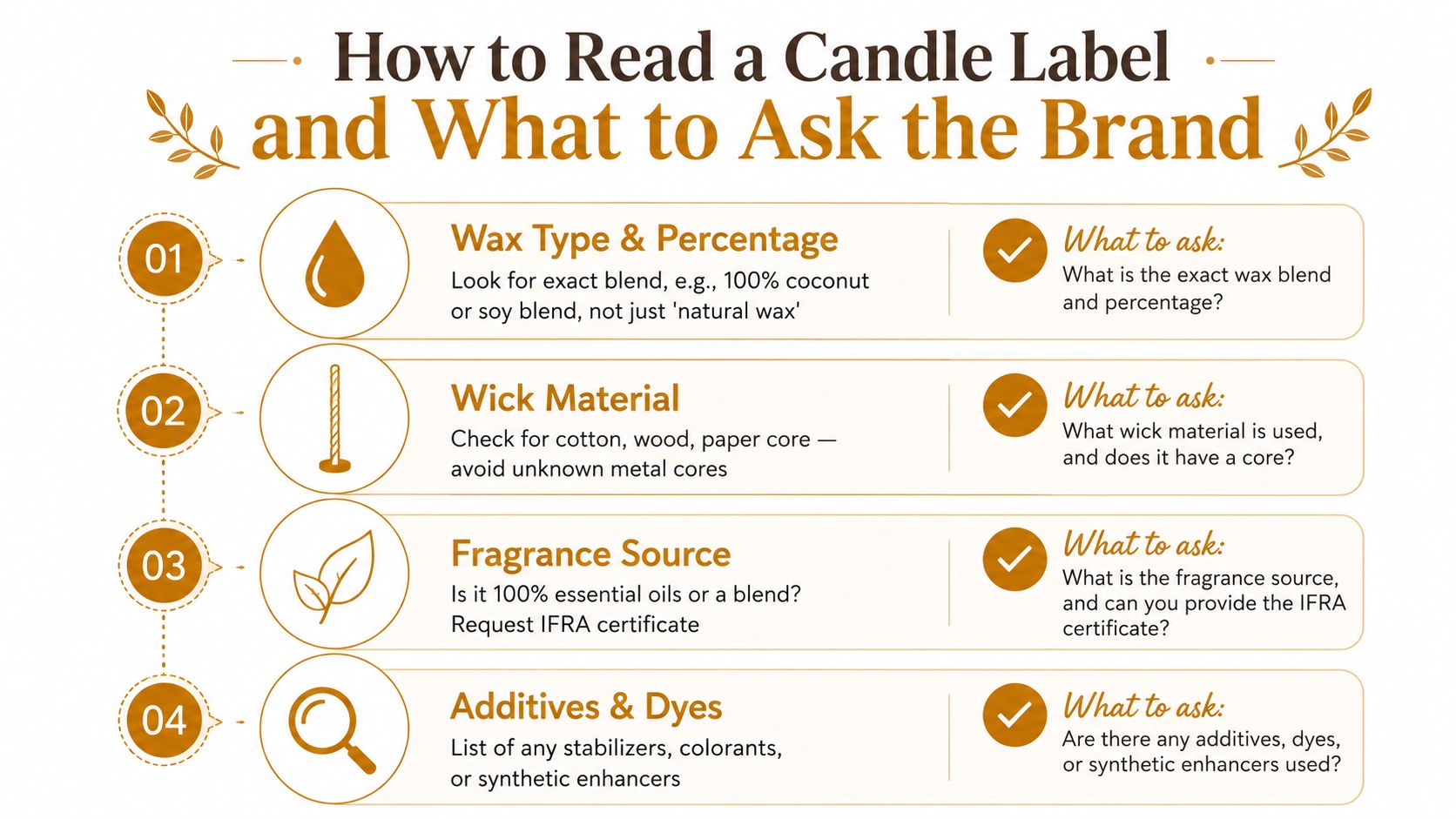
Check the wax description. Look for a named wax or blend, such as coconut, rapeseed, soy, paraffin, or mineral wax. If the product uses a blend, ask whether the proportions are available. A general candle-market guide recommends checking whether the wax is a blend and requesting stated percentages rather than accepting only “natural” or “clean” language. This practical guide to verifying clean-candle claims also recommends checking the actual wick material and fragrance disclosure.
Identify the wick construction. “Cotton wick” tells you more than “premium wick,” but you can still ask whether it has a paper core, contains metal, or has been selected for the vessel size. Wick construction affects flame control and melt-pool formation, so it's part of the performance recipe, not a minor detail.
Look past the word fragrance. “Fragrance” may represent many components. Check the brand's product page for a fragrance house, allergen information, IFRA documentation, or a safety data sheet. A batch code and supplier origin can also help the maker trace the product if a question arises.
Scan additives and claims. Note dyes, pigments, stabilisers, hardening agents, and statements such as phthalate-free. Treat “clean,” “non-toxic,” and “natural” as prompts for questions, not as complete explanations.
Ask for the missing information
A direct message to the brand can be more revealing than another search. Ask whether the fragrance house is disclosed, whether any paraffin used is fully refined, whether colorants are suitable for the intended product, and whether the maker has burn-test results for the specific wick and vessel combination.
Before buying, photograph or screenshot the front label, the ingredients or materials panel, the product description, and any documentation page. Place those images side by side when comparing candles. This turns label reading into a habit you can repeat, rather than a vague impression formed from packaging.
Regulations, Allergen Disclosure, and Certifications Explained
Candle disclosure depends on both geography and the kind of information being requested. A safety label, an allergen statement, a certification, and a full formula are not interchangeable. Understanding that distinction helps shoppers interpret what they see without assuming that a short label proves either quality or danger.
In the European Union, the CLP framework can require named fragrance allergens when they exceed applicable thresholds. Recent European updates have expanded the list of allergens subject to disclosure, so an EU candle may show specific allergen names and hazard information rather than relying only on the word “fragrance.”
The United States presents a different challenge. The Fair Packaging and Labeling Act context for candle ingredient disclosure is commonly discussed in relation to proprietary formulas and trade-secret protection. In practice, a U.S. maker may disclose “fragrance” or “parfum” without publishing every component, which means a concerned buyer may need to contact the brand directly.
Disclosure rules at a glance
| Region or standard | What it requires | What shoppers see on the label |
|---|---|---|
| EU CLP framework | Hazard communication and applicable fragrance-allergen disclosure above relevant thresholds | Named allergens, hazard statements, and safety information where applicable |
| U.S. trade-secret practice | Fragrance formulas may remain proprietary | Generic terms such as “fragrance” or “parfum” may appear |
| IFRA compliance | Fragrance use follows the relevant industry safety standards for the intended application | A brand statement, certificate, or supporting documentation may be available |
| FSC | Certification associated with responsibly sourced forest materials | An FSC mark may appear when the relevant material is certified |
| RSPO | Certification associated with palm-derived ingredients and sourcing | An RSPO mark or sourcing statement may appear |
| Ecocert | Certification connected to defined natural or organic standards | A certification mark, subject to the applicable scheme |
The practical rule is to ask what a symbol verifies. FSC doesn't certify the entire candle. IFRA documentation relates to fragrance safety use, not automatically to wax sourcing or sustainability. A certification can be meaningful without covering every part of the product.
Consumer Questions Versus B2B Transparency Needs
A household buyer and a hotel purchasing manager may hold the same candle, but they need different evidence. The individual wants to know whether the scent is comfortable, whether the candle burns reliably, and whether the vessel can be reused. A B2B buyer must also demonstrate that the product fits procurement, safety, compliance, and reporting requirements.
That difference changes the depth of documentation behind the label. A consumer-facing page may summarize the wax, wick, fragrance, and care instructions. A hospitality account may need SDS sheets, allergen dossiers, REACH and CLP documents, batch traceability, vessel fire-rating information, packaging specifications, and environmental data for internal reporting.
| Transparency need | Consumer buyer | B2B or hospitality buyer |
|---|---|---|
| Composition | Wax type, wick material, fragrance description | Full technical specification, supplier documentation, and change-control records |
| Safety | Burning instructions and relevant warnings | SDS sheets, compliance files, vessel testing, and incident procedures |
| Scent | Whether the aroma matches its description | Consistency across batches, approved fragrance references, and allergen dossiers |
| Supply | Country or region of production | Batch traceability, lead-time information, and continuity planning |
| End of use | Reuse or recycling guidance | Packaging specifications, waste processes, and sustainability reporting data |
| Brand use | Personal preference and home suitability | Guest experience, packaging requirements, and white-label or event needs |
For professional buyers, sustainable candle-making supplies are only one part of the purchasing decision. The buyer also needs confidence that the materials and documentation will remain consistent as orders scale.
B2B transparency often improves consumer disclosure as a byproduct. Once a brand maintains supplier records, batch systems, and compliance documents for professional customers, it has a stronger foundation for answering individual questions accurately.
How The Candledust Builds Transparency Into Every Pearl
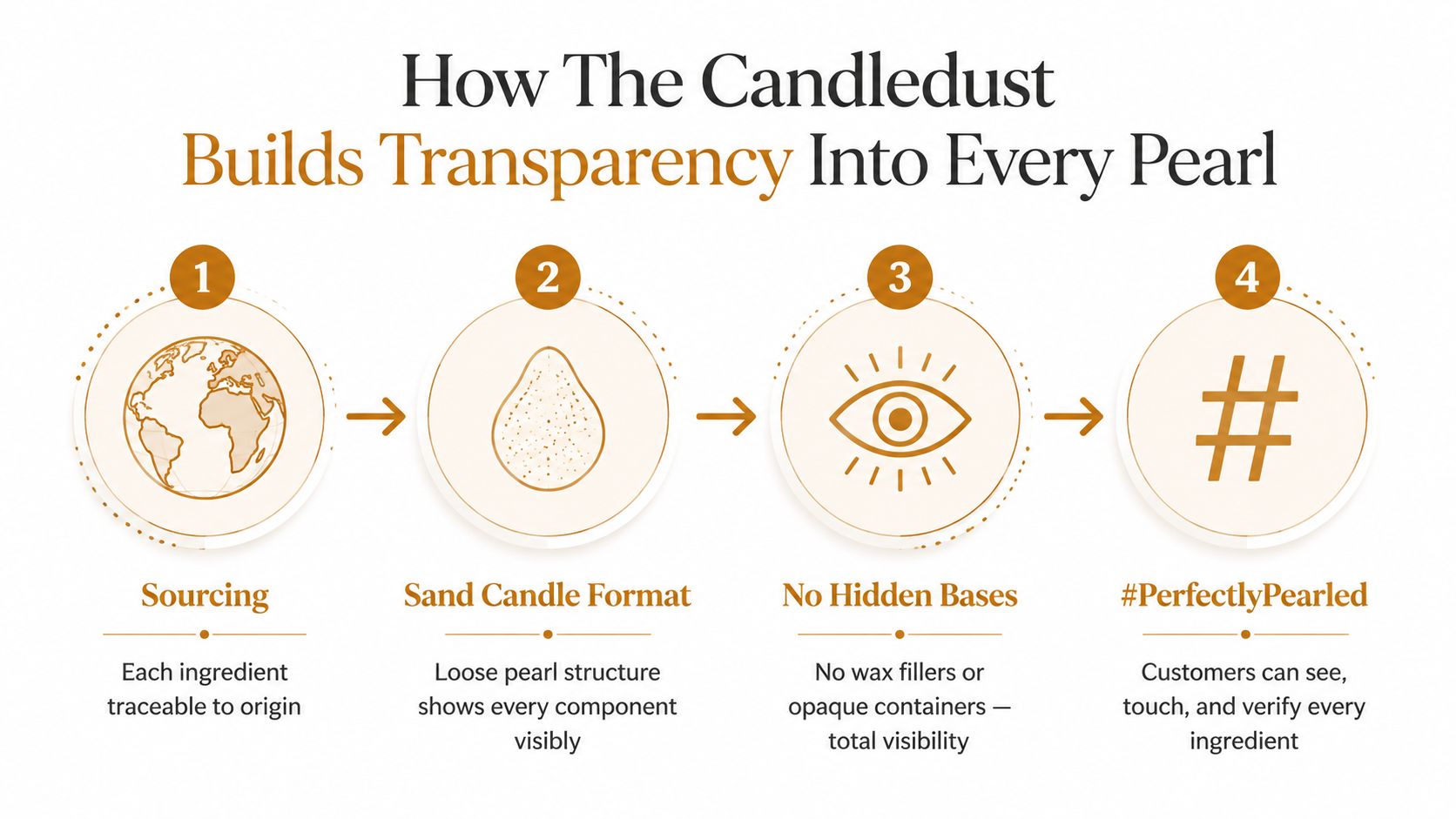
The Candledust's approach begins with the physical form of the product. It produces scented sand candles and positions its processing quality around #Perfect pearl, with special processing designed to create silky, smooth, even candle pearls without lumps or uneven particles. The brand identifies this guaranteed consistency as its most important quality talking point.
The company describes itself as one of the first sand-wax candle producers in the world and as the first to introduce scented sand candles globally. Those statements describe its position in the development of the format, while the more tangible transparency question is what the pearls contain and how they perform in use.
Material choices translated into user benefits
The formula uses a plant-based wax blend based on rapeseed and coconut, without paraffin or soy allergens. That choice gives the buyer a clearer composition to evaluate, while the loose pearl format lets the user portion the wax into a heat-resistant vessel instead of committing to one permanently fixed container.
The wick is cotton. In practical terms, the wick is a replaceable working part rather than a hidden component sealed inside a finished candle. When the candle is finished, the remaining sand wax can be used again with a replacement wick, which connects the material choice directly to waste reduction.
The format is explained in more detail in what candle sand is. A buyer can pour the pearls into a suitable vessel, insert the included wick, and change the arrangement or container for a new use. Glass and aluminium vessels provide reusable options, while the sand itself avoids the need to discard a fixed wax-filled jar after one burn cycle.
The Candledust says its candles are poured in the EU under CLP-aligned fragrance-allergen disclosure, with SDS and IFRA documentation available on request. That documentation can help a buyer move from a broad fragrance promise to records that identify how the fragrance is managed for its intended use.
The result is a clear connection between ingredient transparency and experience. The pearl texture supports even handling, the wax blend supports the candle structure, the cotton wick provides the flame pathway, and the refill system supports vessel reuse. A transparent format doesn't make every formulation decision simple, but it makes more of those decisions visible and easier to discuss.
A Short Transparency Checklist You Can Use Today
Ingredient transparency isn't a badge you check once. It's a buying habit that helps you compare a candle's stated materials with the experience you want, whether that means a gentle scent, a reusable vessel, a dependable flame, or less leftover waste.
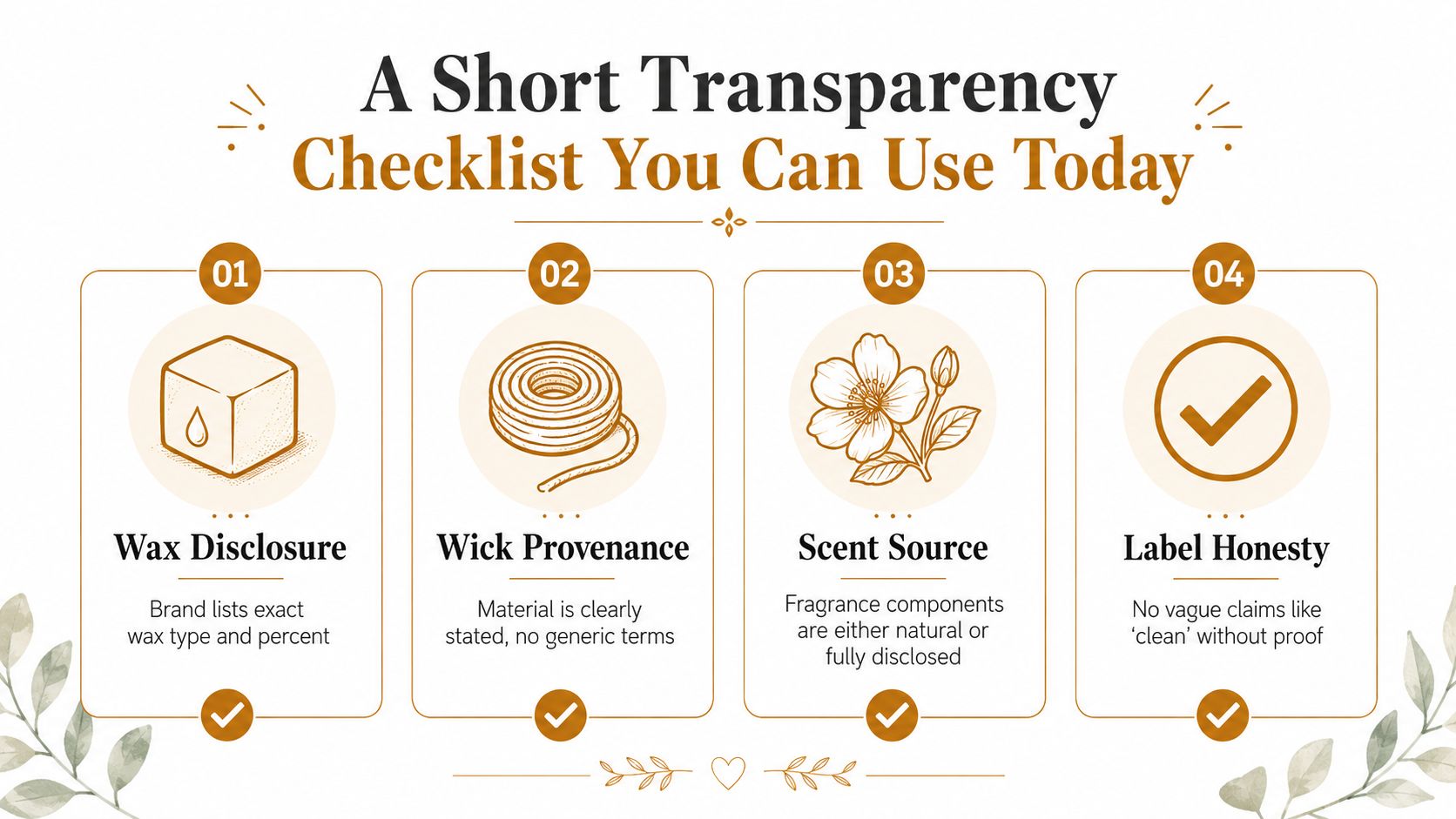
Use four quick passes before placing your next order.
The first pass checks the product identity
Look at the front label and product title. Can you identify the wax type, wick material, country or region of production, and whether the item is a candle, refill, or fragrance product? If the wording only says “natural,” “clean,” or “eco,” treat that as an invitation to look for the actual materials.
The second pass checks safety information
Read the back panel and product page for fragrance-allergen disclosure, CLP symbols where applicable, warnings, and burning instructions. Check whether the stated burn-time claim belongs to the exact vessel and wick combination, rather than assuming every setup will behave identically.
The third pass checks the brand's documentation
Search the maker's website for SDS files, IFRA statements, material descriptions, batch information, and guidance for recycling or reusing the vessel. A refill or take-back program can reveal more about waste reduction than a general sustainability phrase.
The fourth pass asks the unanswered question
If the wax percentage, wick construction, fragrance source, or additive information is missing, contact the brand. Ask one precise question and judge the response. A transparent operation won't treat a reasonable request for material information as an inconvenience.
Practical rule: The strongest label is not the one with the most impressive claim. It's the one that explains what each material does and provides a path to verify the details.
Before you buy, save the product page and label images so you can compare them later if the formula, fragrance, or packaging changes. The best candle brands treat these questions as routine, not intrusive, because clear answers are part of the product experience.
The Candledust offers plant-based scented and unscented candle sand, reusable vessels, and replacement wicks, with material information designed to help you understand how the format works. Visit The Candledust to explore the candle-sand collection and choose a refillable setup you can inspect, reuse, and make your own.