

You've set a candle on a dinner table, poured sand wax into a favorite glass, or prepared dozens of vessels for an event. The flame looks simple, but the wick is doing precise engineering work. Its material affects how it stands, how much wax reaches the flame, how large the melt pool becomes, and what can enter the indoor air during burning.
That's why lead free candle wicks deserve more than a reassuring label. The safest choice combines a suitable wick material, correct sizing, controlled burning, and a supply chain that can document what the wick contains. For home users, event planners, restaurants, and hospitality buyers, that approach is more useful than treating every candle as equally risky or assuming every “lead-free” claim means the same thing.
Table of Contents
- Why Wick Composition Matters for Your Health
- The Regulatory Journey from Lead Wicks to Safety Standards
- Lead-Free Wick Materials and How They Perform
- Choosing the Right Wick for Sand Wax and Different Vessels
- Maintenance and Burning Techniques for Safety and Performance
- Understanding Lead-Free Claims and Supply Chain Verification
- Making Informed Choices for Health and Sustainability
Why Wick Composition Matters for Your Health
Before guests arrive, you light a scented candle and watch the flame settle in its glass vessel. The fragrance soon draws attention away from the wick, although that small bundle of fibers or supporting material controls how wax reaches the flame and what is heated above it. Its construction affects the flame, the melt pool, and the material present at combustion temperatures.
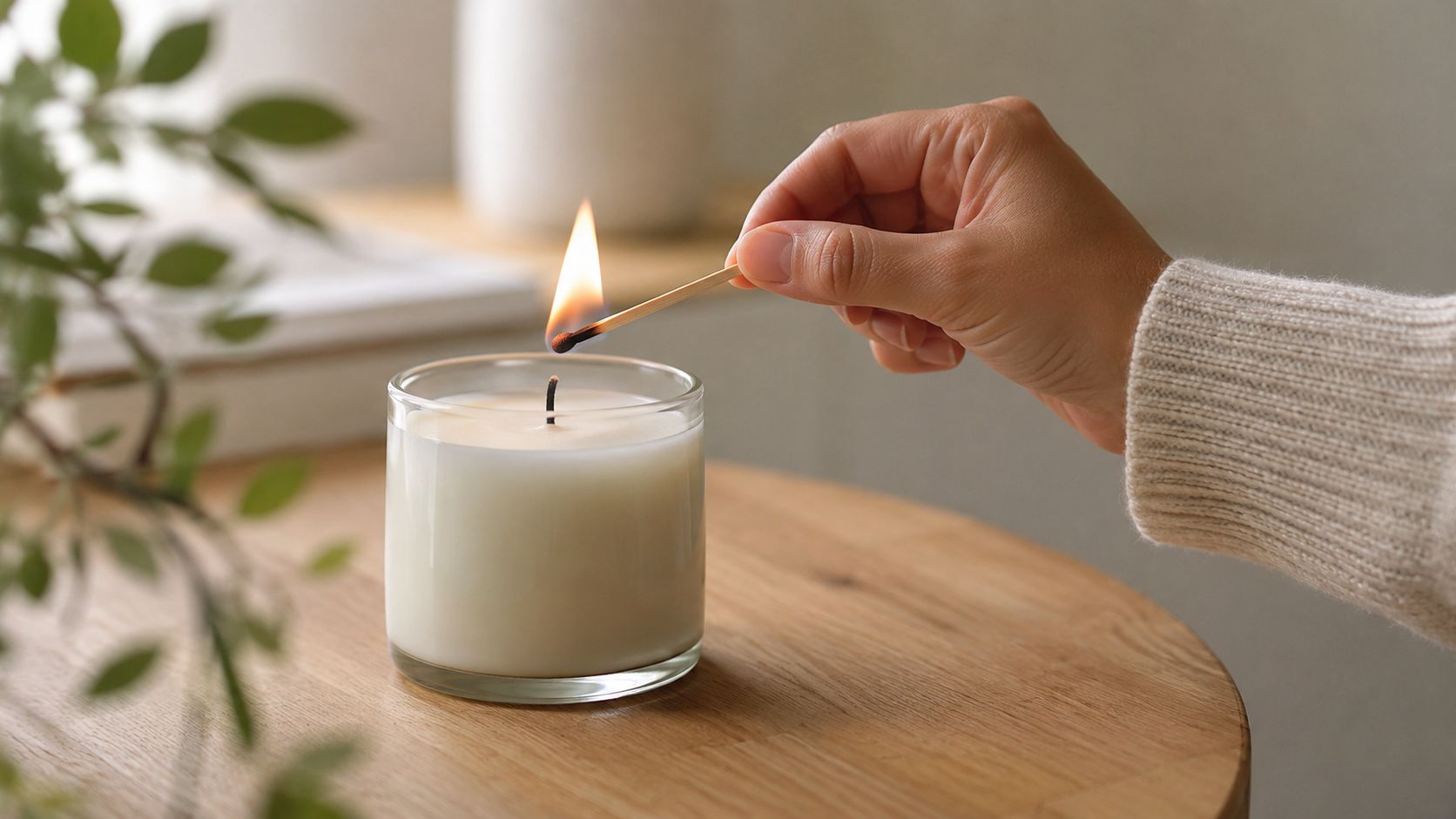
Cotton and paper wicks draw liquid wax upward through their fibers. A metal core adds stiffness, helping a wick stay upright as the surrounding wax melts. These designs do not behave identically in a burn. A wick may bend, develop a carbon cap, smoke, or produce an unsteady flame, changing the candle's overall performance.
Why indoor exposure deserves attention
Historical assessments found that lead from some metal-core wicks could enter indoor air during burning. A 1999 candle-wick emissions study estimated that about 20% of the lead in a wick could be emitted, with potentially unacceptable exposure under certain conditions (the PubMed record for the candle-wick emissions study). European risk documents also identified lead wicks in sampled candles and warned that emissions could affect sensitive groups, including people exposed to candle smoke in enclosed rooms.
Those findings describe a historical hazard, not the risk profile of every candle sold in a regulated domestic market. Imported candles can still carry residual contamination or incomplete composition records, however. For restaurants, hotels, event planners, and other buyers burning many candles for extended periods, verification matters more than a reassuring package claim. The practical question is what the wick contains and whether the supplier can document it.
Practical rule: Ask what the wick is made of, where it was produced, and what documentation supports that description.
Marketing language versus useful information
Words such as “natural,” “clean,” and “non-toxic” describe positioning, not necessarily wick construction. A useful product description identifies the material, such as cotton, paper, synthetic fiber, or zinc-core, and connects it with a recognized specification where one applies.
For a practical explanation of lead-free candles and wick safety, review the material and sourcing questions that support a safer purchase. Wick composition is one part of indoor-air awareness. Responsible use also depends on ventilation, suitable wick sizing, and watching for smoking, excessive soot, or unstable flame behavior.
The Regulatory Journey from Lead Wicks to Safety Standards
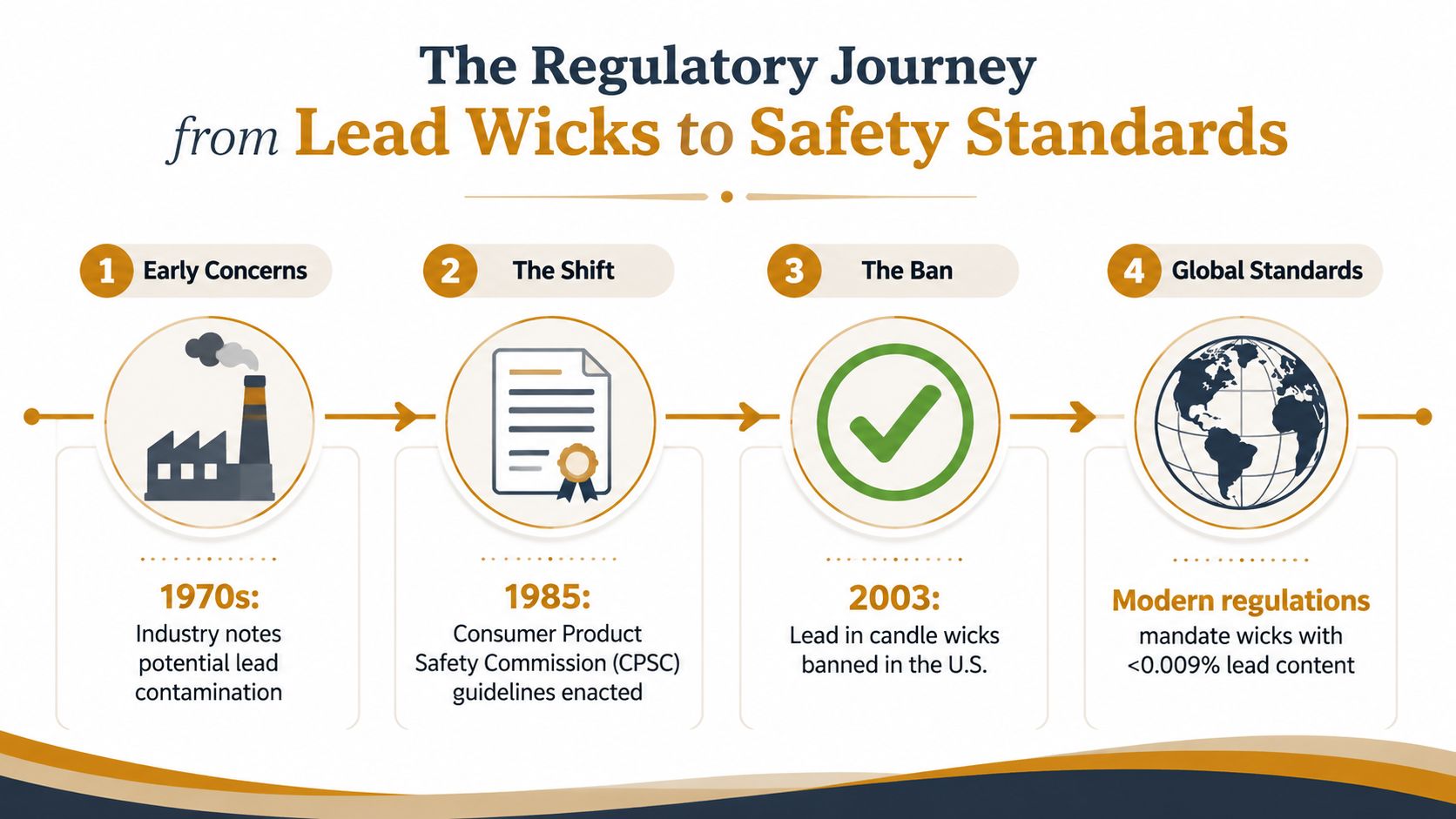
The United States moved from industry warnings to a formal prohibition in stages. A New York Times report dated December 14, 1976 said that the Consumer Product Safety Commission had already warned about lead-core candle wicks. It also reported that most of the industry had abandoned the practice three years earlier, placing the broad shift away from lead-core wicks around 1973 (the historical report on lead-core candle concerns).
Australia moved earlier in policy terms. In 2001, it announced that it was the first country in the world to ban candles containing any lead in wicks. After expert advice, its permanent limit aligned to 0.06% lead by weight (the Australian Treasury announcement on lead candle wicks).
What the U.S. rule actually says
In the United States, the Consumer Product Safety Commission voted unanimously in 2003 to prohibit the manufacture, import, and sale of candles with lead-cored wicks. The rule applies to domestic and imported candles. Products manufactured or imported on or after October 15, 2003 fall under the federal rule (the CPSC announcement of the candle-wick ban).
The legal benchmark isn't a vague promise. The metal core of a candle wick must contain no more than 0.06% lead by weight. The federal rule also requires conforming packaging language for candles with metal-cored wicks under the relevant regulation (the CPSC candle business guidance).
Why the threshold matters to buyers
The CPSC identified the 0.06% threshold as the least burdensome way to reduce illness risk from lead exposure. The standard applies to the metal core, not to the cotton covering around it. That detail matters because a wick can look like ordinary fiber while still containing an internal wire.
Nonmetal-cored wicks aren't subject to the same certification requirement described for metal-cored wicks. That doesn't make every fiber wick automatically suitable for every candle. It means the compliance question changes according to construction. Buyers should request a material declaration, manufacturing information, and any applicable test or quality documentation instead of treating “lead-free” as a complete technical specification.
Lead-Free Wick Materials and How They Perform
Lead-free alternatives aren't interchangeable. Cotton, paper, synthetic fiber, and zinc-core constructions each solve a different engineering problem, and the wick must match the wax, vessel, and intended flame.
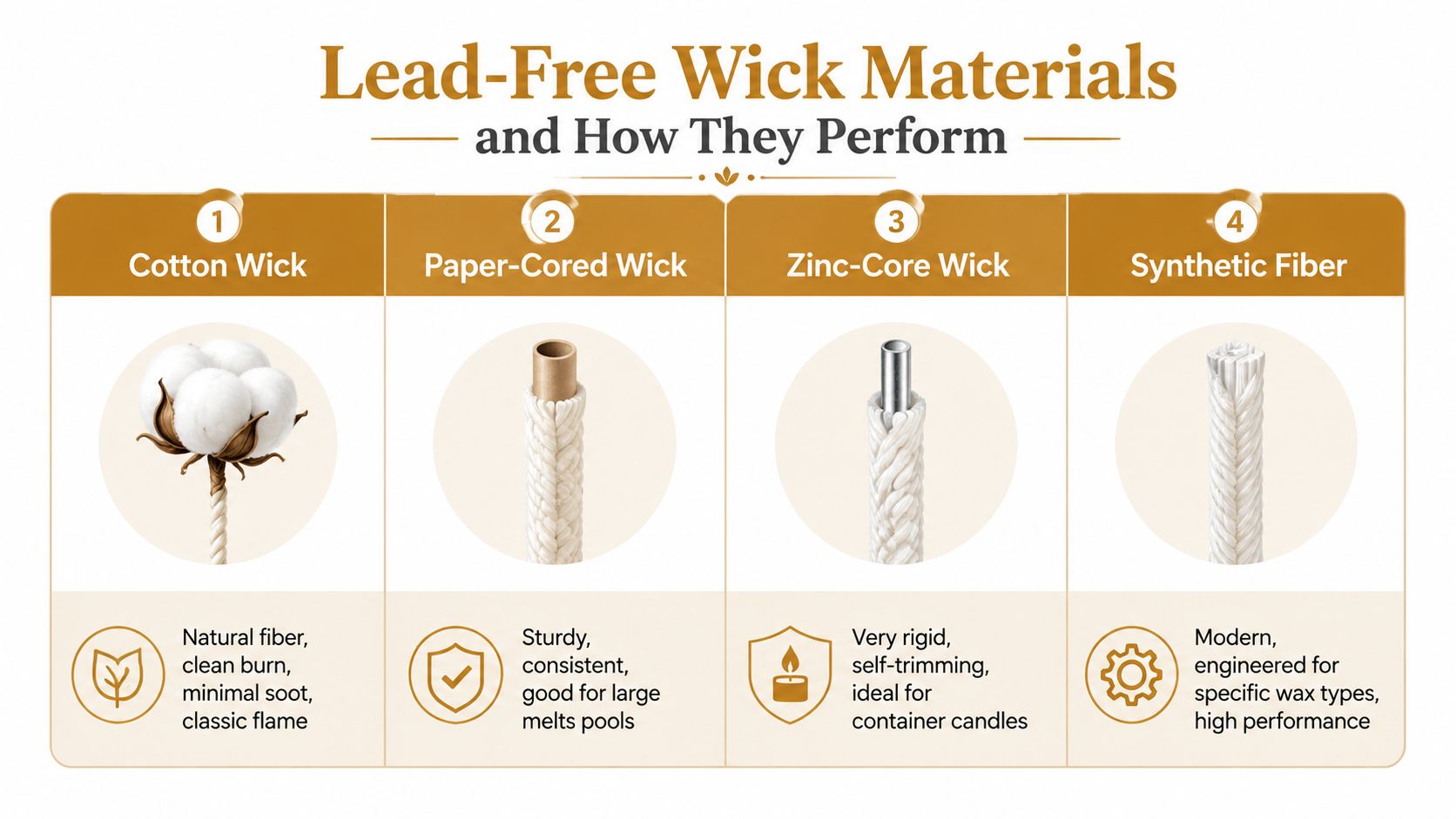
| Wick construction | Main characteristic | Selection consideration |
|---|---|---|
| Cotton | Flexible fiber with familiar burn behavior | Requires suitable sizing and placement |
| Paper | Fiber-based rigidity | Can support consistent positioning in some formats |
| Zinc-core | Rigid metal-core construction without lead | Useful where upright support matters, but still requires material verification |
| Synthetic fiber | Engineered fiber construction | Must be matched carefully to the wax formulation |
Cotton is often the simplest starting point for makers. It can be braided or structured for stability, but its performance still depends on diameter, wax viscosity, fragrance load, vessel width, and airflow. Paper constructions provide another non-lead option where additional stiffness helps the wick remain positioned during the burn.
Diameter changes the flame
Zinc-core performance data show how dramatically wick dimensions can alter combustion. Smaller-diameter examples consumed roughly 0.10 oz per hour and produced flames of about 0.98 inches, while larger examples reached approximately 0.30 oz per hour and about 2.9-inch flames (zinc-core wick performance data from Wicks Unlimited). These figures aren't universal promises. They demonstrate the relationship between wick size, wax consumption, flame height, melt-pool diameter, and combustion intensity.
A wick that's too small may leave unmelted wax around the vessel edges. A wick that's too large can create excessive heat, a tall or unstable flame, and more visible soot. Synthetic fibers can be engineered for particular wax systems, but that precision makes supplier guidance and testing more important, not less.
For makers comparing supplies, sustainable candle-making supplies should be evaluated alongside wick specifications, vessel reuse, and the ability to replace only the component that has finished burning. Wicks are included with The Candledust products, and makers who need additional pieces can review Extra wicks 6cm (1000pcs). The listed snapshot describes each wick as 5 cm long without a sustainer.
Choosing the Right Wick for Sand Wax and Different Vessels
Sand wax changes the practical setup because the candle begins as loose particles rather than a solid block. The wick must stand securely in the poured material, and the vessel still controls the available melt area and heat distribution. A reliable choice starts with the complete system, not the wick in isolation.
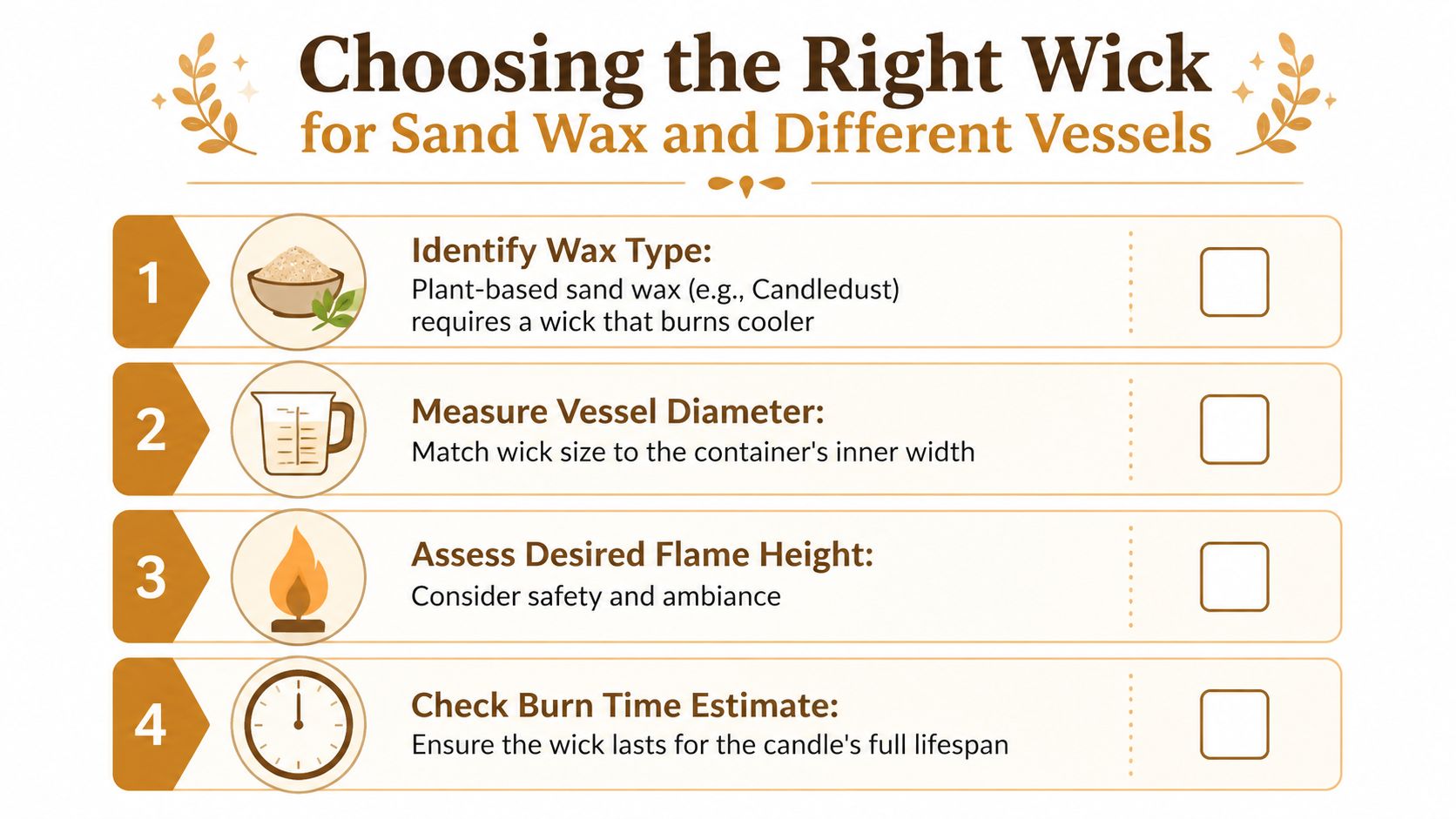
Start with the wax and vessel
For a plant-based sand-wax product such as Candledust, use the wick specified for that system and place it upright in the center of the vessel. The vessel's inner width matters because a broad container needs a flame and melt pattern capable of reaching farther across the surface, while a narrow vessel can become overheated by an unnecessarily large wick.
Use this decision sequence:
Identify the wax format. Loose sand wax, a firm pillar wax, and container wax don't transfer heat in exactly the same way. Follow the supplier's recommended wick family before experimenting.
Measure the inner diameter. Don't judge by the vessel's outside appearance. Measure the usable interior width, then compare it with the wick guidance supplied for that wax.
Choose the intended flame character. A calm, modest flame may suit a dining table, while an event centerpiece may require a different visual balance. Safety and stability should come before height.
Test the complete arrangement. Use the actual vessel, wax depth, fragrance level, and placement conditions. Observe whether the flame stays upright, whether the melt area develops evenly, and whether smoke or soot appears.
Read the burn rather than guessing
Persistent tunneling suggests that the wick isn't delivering enough heat across the surface. Drowning can indicate that the wick is too small, too short, or surrounded by wax that reaches it faster than it can consume fuel. A large, flickering flame or heavy soot suggests excessive wick size, a draft, or a wick that needs maintenance.
A reusable sand-wax system makes replacement part of normal operation. When the wick has completed its useful life, remove it, let the vessel cool, and position a fresh wick before adding or redistributing the remaining sand. The multiple-wick candle guide is relevant when a vessel is broad enough that one central flame can't create the desired burn pattern.
For a colored option, Amethyst Unscented Candle Sand by KG / LBS is described as a purple candle sand suitable for glass and ceramic vessels. Whatever color you choose, test the wick with the actual fill depth and container rather than transferring assumptions from another candle.
Maintenance and Burning Techniques for Safety and Performance
A lead-free wick still needs care. Correct material can't compensate for a wick that has grown too long, sits in a draft, or is paired with a vessel it can't heat evenly.
Prepare before lighting
Keep the wick upright and centered. Remove loose debris from the surface, check that the vessel is heat-resistant, and place it on a stable, level surface away from moving air. If the wick has developed a visible carbon buildup, allow the candle to cool and remove the excess before relighting.
The first burn gives you useful information. Watch the flame rather than leaving the candle unattended. A steady flame generally indicates a balanced setup, while persistent flickering, smoking, or unusual height calls for a pause and an adjustment.
Use a simple observation routine
- Watch the flame: A stable flame is preferable to one that repeatedly leans, flares, or smokes.
- Inspect the melt area: The wax should melt in a controlled pattern without rapidly overheating the vessel.
- Respect the setting: Drafts from doors, fans, and air-conditioning can distort the flame and increase soot.
- Replace spent wicks: In reusable sand-wax systems, remove the old wick after cooling and insert a fresh one rather than forcing a depleted wick to continue burning.
Hospitality teams should include wick checks in setup and closing routines. A staff member can confirm that every vessel has a centered wick, clear surroundings, and a flame behaving consistently before guests arrive. That small habit supports both presentation and safer operation without relying on the wick label alone.
Understanding Lead-Free Claims and Supply Chain Verification
A hospitality buyer may receive two candles with the same “lead-free” label, yet have very different evidence behind them. One may come from a regulated domestic supplier with identified materials and records. The other may be an imported, unbranded product whose wick construction is unclear. The label describes a claim, not automatically the scope or quality of its verification.
The historical concern remains relevant. Earlier testing found that lead from metal-core wicks could enter the air during burning, with about 20% of the lead in a wick estimated to be emitted, as noted in the earlier research (the PubMed study on lead emissions from candle wicks). For current purchasing, the practical question is traceability. A named supplier that identifies the wick and supports its materials claim presents less uncertainty than an anonymous listing with no construction details or documentation.
Ask for evidence that matches the construction
For a metal-core wick, request confirmation that the core meets the applicable lead limit. In the United States, the limit is no more than 0.06% lead by weight, including imported candles manufactured or imported on or after October 15, 2003 (the federal candle rule and CPSC guidance). The document should apply to the actual wick or finished candle, not merely to a supplier's general product range.
For a nonmetal wick, ask the supplier to identify the fiber and provide a material declaration. RAL-GZ 041 offers another reference point. For certain wick series, it requires cotton to meet OEKO-TEX Standard 100 Class I or II and limits wick metals to 5 mg/kg lead or 5 mg/kg nickel (the RAL-GZ 041 lead-free wick statement).
A practical procurement checklist
- Name the wick: Confirm whether it uses cotton, paper, synthetic fiber, zinc core, or another construction.
- Trace the source: Ask where the wick and finished candle were manufactured.
- Match the document: Check that the declaration or test covers the exact wick series.
- Review the market: Treat anonymous listings and poorly documented imports as higher-uncertainty purchases.
- Keep records: Hospitality and event buyers should retain declarations for repeat orders, substitutions, and supplier reviews.
For recurring venue orders, composition records provide a clearer basis for decisions than the phrase “lead-free” alone.
Making Informed Choices for Health and Sustainability
A responsible wick decision balances composition, performance, documentation, and waste reduction. Choose a wick that suits the wax and vessel, then verify that the supplier can identify its materials and support its safety claim. For reusable sand-wax formats, replacing the spent wick instead of discarding the remaining material can support a lower-waste routine.
Quality also starts with the wax itself. The Candledust produces plant-based candle sand in a specially processed format designed to create silky, smooth, even candle pearls without lumps or uneven particles. The company calls this #Perfect pearl, and presents that consistency as its most important quality talking point. It describes itself as one of the first sand wax candle producers in the world and among the first to introduce scented sand candles globally, a novelty claim that should remain narrowly understood because scented candles have much older roots, including aromatic candle traditions in ancient cultures (a history of scented candles).
Choose a wick by material, test it in the vessel you'll actually use, and request documentation before placing repeat orders for a venue or event. Explore the reusable sand-wax formats, replacement wicks, and scented or unscented options at The Candledust, then build your next candle around a verified wick and a consistent burn setup.