

You can light two beautiful candles in the same room and still end up with a muddled mess. The table looks perfect, the jars are gorgeous, and the room smells like two different ideas fighting for attention. That's the challenge with candle scent combinations; they have to work together in the air, not just impress you one at a time.
Table of Contents
- Why Most Candle Scent Combinations Fail
- Understanding the Scent Wheel and Fragrance Notes
- Blending Ratios and Testing Protocols
- Curated Scent Combination Recipes for Every Occasion
- Designing Room-Level Scent Architecture
- Experimenting with The Candledust Sand Wax System
- Your Next Steps for Confident Scent Blending
Why Most Candle Scent Combinations Fail
A dinner host can spend an hour choosing linens, glassware, and flowers, then light two candles that should have worked beautifully. One smells like vanilla pastry, the other leans sharp and bright, and instead of a polished atmosphere, the room fills with a confused, cloudy aroma. The issue is usually that the pair was chosen by feeling alone, while each candle was judged in isolation.
Shoppers often select candles because they enjoy each scent on its own. They do not ask how one scent opens, how another lingers, or whether the two candles will compete once they are burning in the same room. That is why successful candle scent combinations depend on structure, not just preference, and why room-level planning matters as much as the candles themselves.
Scent skill is learnable
Candle blending may feel intuitive, but stronger results come from a repeatable method. Fragrance design often follows a three-layer structure of top, heart, and base notes, and candle-making guidance uses that same model to build balance. A major candle-supply source recommends combining 2 to 4 oils that cover those note levels, then testing the blend carefully before committing to a full batch (Lone Star Candle Supply scent guide).
Practical rule: If a blend only smells good in the bottle, it is not finished.
That shift in mindset matters because a candle artisan is not chasing a single perfect note. The goal is a scent that behaves well over time and across the room, especially when several candles may be burning together and each one has to leave space for the others.
Premium scented candles now account for 71.8% of the scented segment, which says a lot about what shoppers want from fragrance today. People are buying more than a smell, they are buying a layered experience for settings such as a restaurant table, a wedding aisle, or a quiet evening at home. For readers comparing oil choices and blend behavior, the difference between fragrance oil vs essential oils also shapes how a scent performs once it is dispersed in a space.
Understanding the Scent Wheel and Fragrance Notes
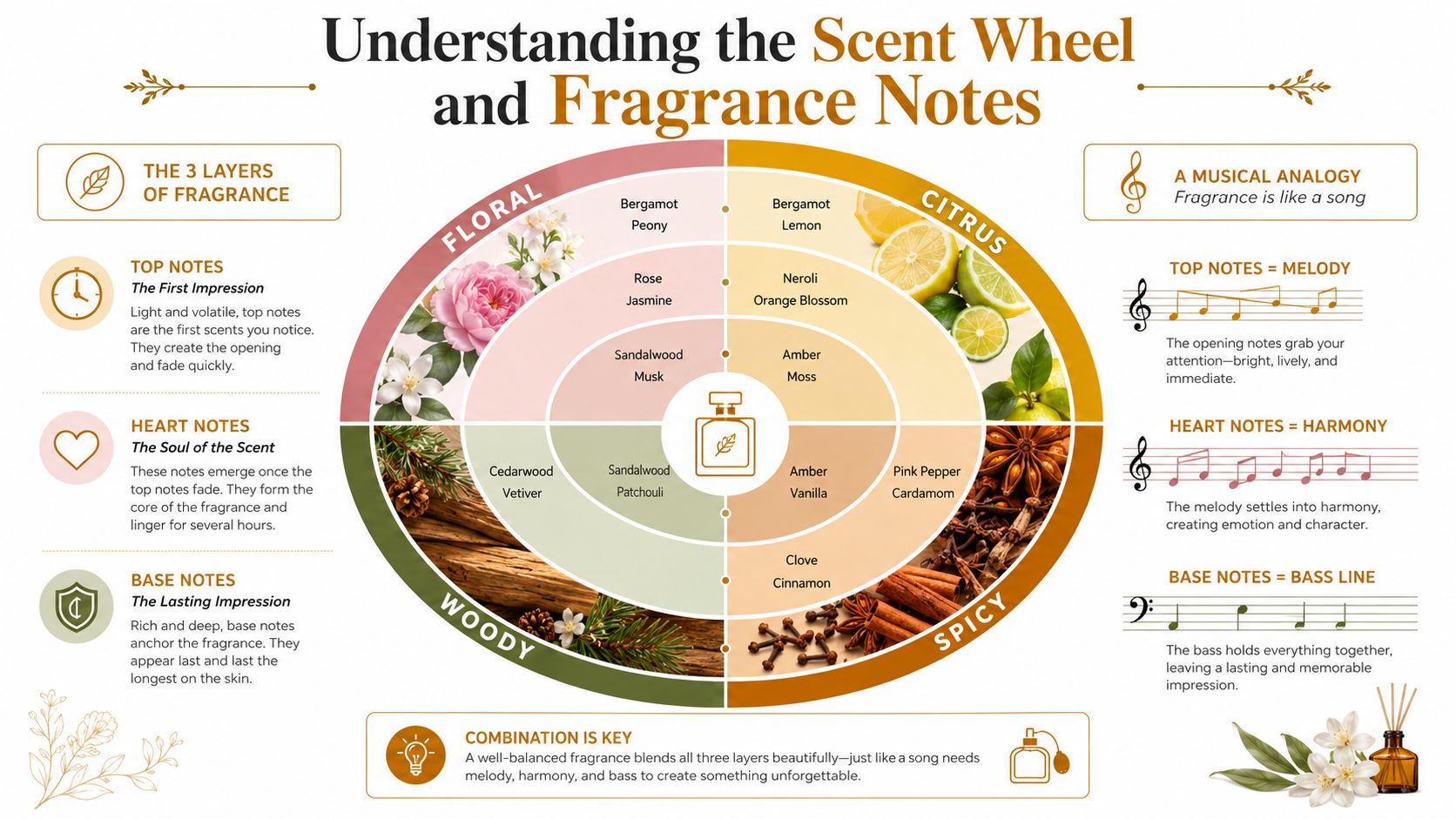
A candle blend often fails for a simple reason, the notes are speaking at the same volume. A scent wheel helps you sort the roles before you pour wax. Top notes open the fragrance with brightness, heart notes carry the main character, and base notes hold the finish in the room after the flame settles.
How the wheel helps you pair scents
Start with families before you start with bottle names. Floral, citrus, woody, oriental, fresh, and gourmand are the broad groups most candle makers reach for, because they give you a map before you begin mixing. Adjacent families usually sit together with less friction, while opposite families create more contrast, which can help when you want lift, tension, or a cleaner edge in a larger room.
The note pyramid matters because a good pairing is not just a list of pleasing smells. It is a sequence. A 2019 arXiv study on perfume composition identified 424 significant 2-note accords and 764 significant 3-note accords, including combinations such as Oakmoss + Lemon + Amber and Jasmine + Violet + Cedar. That does not mean candle makers should copy perfume formulas line for line, but it does show that some combinations naturally hold together while others fall apart.
Bottom line: blends usually feel coherent when they share at least one structural idea, even if the raw notes seem unrelated.
Room-level scent design adds another layer. A candle that smells balanced on its own can still fight with another candle across the room if both are loud in the same note family. That is why a blend should be judged as part of a small group, not only as a single jar on a counter. A soft floral in one corner and a restrained citrus in another can read as fresh and open together, while two heavy gourmands may make the space feel crowded. The wheel helps you decide which candles can share air without stepping on each other.
For beginners, consumer preference is a useful anchor. A 2026 industry summary reports that vanilla holds about 11% of worldwide scented-candle fragrance share, while citrus and lemon are close behind at roughly 10%. Those figures help explain why soft gourmand plus fresh bright note pairings are often forgiving. Vanilla smooths sharp edges. Citrus keeps the blend from settling too low.
A simple mental map
- Floral pairs well with citrus, musk, and woods.
- Citrus pairs well with herbs, greens, and soft vanilla.
- Woody pairs well with amber, spice, and resin.
- Gourmand pairs well with spice, citrus, and smooth woods.
These pairings matter even more when several candles burn in the same space. A floral candle can act like the high voice in a chorus, while a woody candle anchors the room with a lower register. If you place them thoughtfully, the scent feels layered instead of crowded. If every candle sits in the same family, the room can turn flat or muddy, even when each jar smells pleasant on its own.
The type of oil also changes how clearly those roles show up in wax. For a clear comparison of how different oil types behave, this fragrance oil guide is a useful reference when you are deciding which materials to blend and how predictable you want the result to be.
Blending Ratios and Testing Protocols
A blend can smell lovely in the bottle and still fail in wax if the structure is off. That is why reliable candle scent combinations begin with a ratio, not a guess. Waxverse suggests a practical starting point of 30% top notes, 50% heart notes, and 20% base notes by fragrance weight (Waxverse candle scent combinations).
Start with weight, not memory
Measuring by weight keeps the result repeatable. If the heart note is meant to carry the blend, the formula has to give it that job. In practice, many candle makers begin with 2 to 4 oils that cover different note levels, then adjust in small steps instead of rebuilding the whole blend each time.
The wax sets the limits. Candle-making guidance commonly places fragrance oil usage at 6% to 10% of wax weight, with a typical calculation of 6 to 10 g fragrance oil per 100 g wax (Candlewic advanced scent blending techniques). Go beyond that range and burn quality can suffer, even if the blend smells strong in the jar.
For room-level scent architecture, those numbers matter even more. A single candle may smell balanced on its own, but several candles in one space need to share the air without crowding each other. A clean citrus candle can lift a heavier woody one, while a soft vanilla base can smooth a sharper floral nearby.
A repeatable testing workflow
- Build a small trial blend. Use 2 to 4 oils that cover top, heart, and base notes.
- Test ratios like 1:1 or 4:1. These give quick signals about which note leads and which one supports.
- Let the blend rest before deciding. Early impressions can be misleading because the notes have not settled together yet.
- Pour a test candle at about 180°F. That keeps your comparisons more consistent from one batch to the next.
- Burn the candle, not just sniff it cold. Hot throw often behaves differently from cold throw, and many promising blends fall apart only after flame time.
- Compare it in a room, not just on a table. Place the test candle near another mild candle or across the room from one, then check whether the scents layer cleanly or turn muddy.
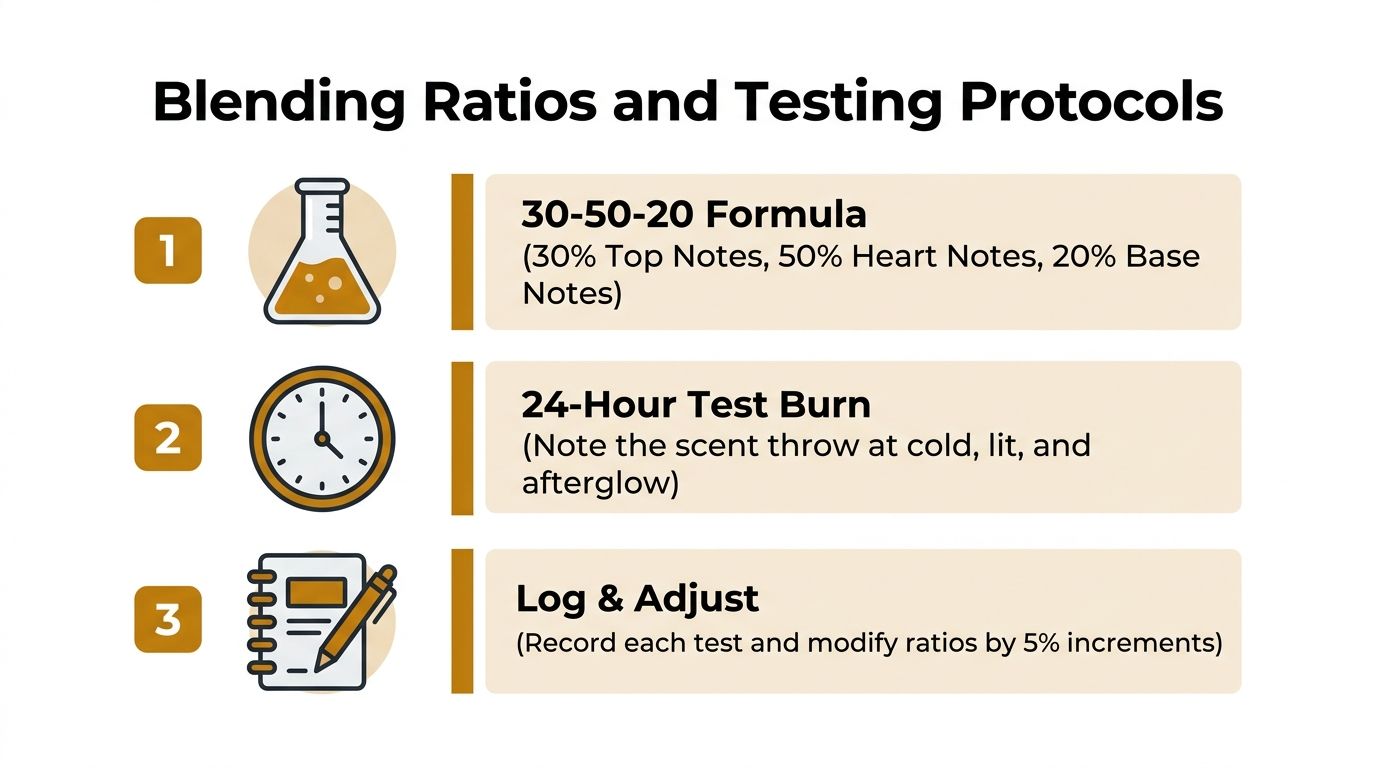
Useful habit: log each trial in grams, not drops. Drops vary too much to help when you scale up.
A small notebook, a kitchen scale, and a disciplined burn test will tell you more than a shelf full of pretty labels. If you want a low-risk way to compare several scent families side by side, a candle discovery set can make the first round of trials easier to read. Once a formula survives cold sniff, rest time, and flame, it is ready for larger batches.
Curated Scent Combination Recipes for Every Occasion
The easiest way to learn is to begin with blends that already make sense in the room. These recipes use the same scent-wheel logic and ratio framework from earlier, but they are arranged by mood and use case so you can choose with less guesswork. Some read bright and clean, others feel cozy and enveloping, and a few are better for spaces where people stay for hours.
Seasonal Candle Scent Combination Quick Reference
| Season | Top Notes | Heart Notes | Base Notes | Ratio |
|---|---|---|---|---|
| Spring | Lemon, green leaf | Jasmine, rose | Soft musk | 30/50/20 |
| Summer | Citrus, bergamot | Neroli, herbal notes | Light vanilla | 30/50/20 |
| Autumn | Apple, orange peel | Cinnamon, clove | Amber, woods | 30/50/20 |
| Winter | Peppermint, citrus | Vanilla, cocoa | Cedar, resin | 30/50/20 |
Seasonal blends
A spring blend works best when it feels airy without turning thin. Try lemon, jasmine, and soft musk for a fresh room that still feels polished. For summer, citrus, neroli, and light vanilla gives brightness without drifting into candy-sweet territory.
Autumn asks for more depth. Orange peel, cinnamon, and amber brings warmth, while apple, clove, and woods feels more rustic and dinner-friendly. Winter can move in two directions, either crisp and lifted with peppermint, vanilla, and cedar, or richer with citrus, cocoa, and resin.
Event and hospitality pairings
For romantic dinners, a blend like bergamot, rose, and sandalwood keeps the room elegant without crowding the food. Weddings often need something softer, so peony, white tea, and clean musk works as a gentle backdrop. Corporate gatherings usually benefit from restraint, and citrus, herbs, and cedar feels professional without smelling sterile.
Hotel lobbies and restaurant dining rooms need scents that read clearly in passing. Citrus over amber creates lift with weight underneath, while herbal over woody gives a cleaner first impression. Spa spaces do better with lavender, eucalyptus, and soft woods, because the scent should steady the room instead of announcing itself.
Signature home blends
If you want a dependable home blend, start with vanilla, citrus, and cedar. The vanilla gives comfort, the citrus keeps it open, and the cedar stops it from feeling flat. Another strong option is jasmine, violet, and cedar, a combination that mirrors the kind of accord structure described in fragrance composition research.
Practical rule: if a room is small, choose one dominant family and let the others support it. If a room is large, let the blend carry a little more contrast.
These recipes are not meant to lock you in. They give you a stable first draft so you can adjust toward brighter, warmer, softer, or cleaner depending on the space.
Designing Room-Level Scent Architecture
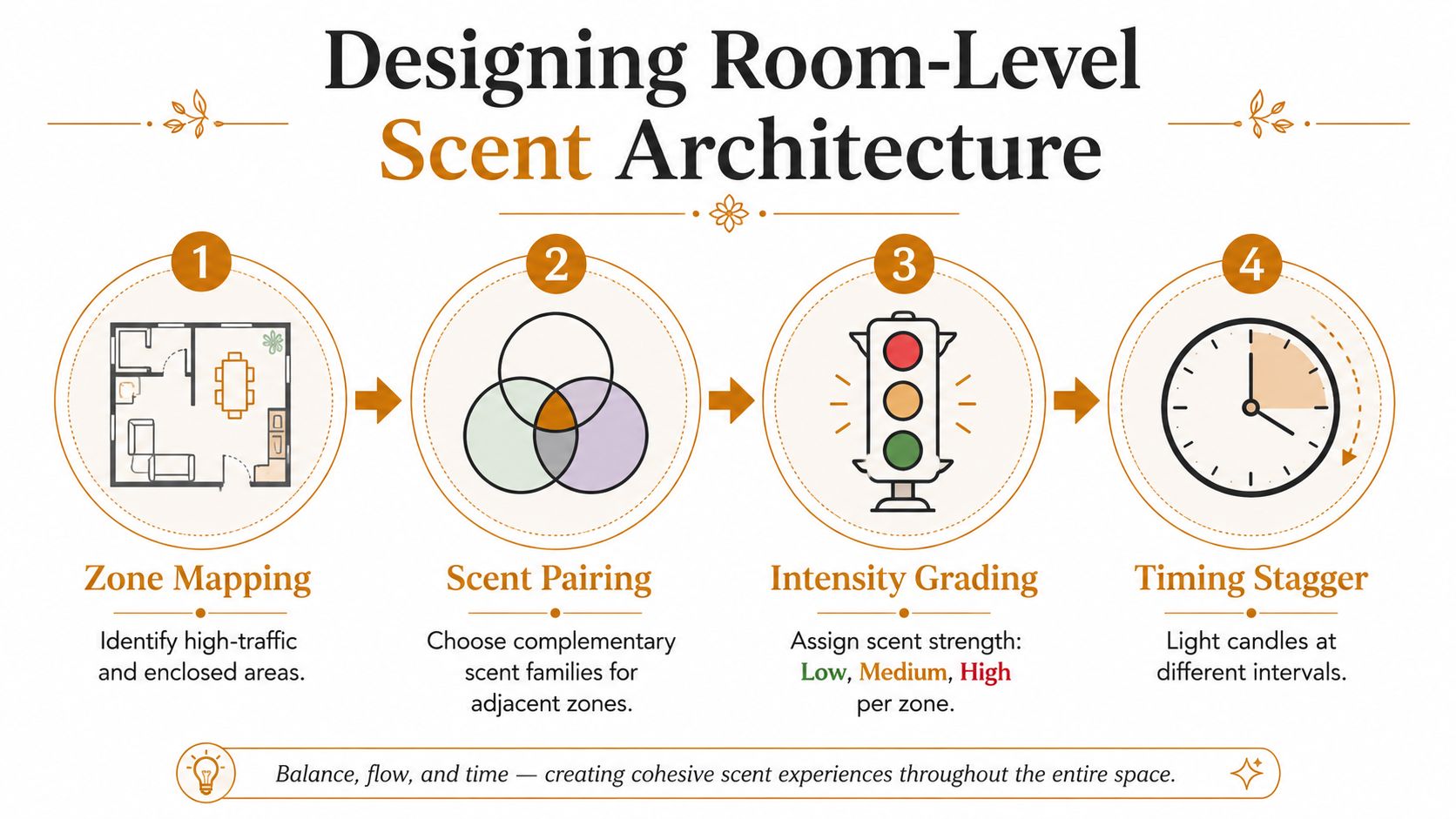
A room with several candles needs a plan. Without one, even good candles can collide, especially when one sits near an entryway, another at the dining table, and a third by the sofa. The goal is not to make every candle smell the same, it's to give each zone a role.
Build the room in zones
Start by deciding which candle owns which part of the room. In a narrow entry, a brighter note usually works best because it reads quickly. In a dining area, a warmer scent keeps the space grounded, especially if food is part of the evening.
Independent home-fragrance guidance says two to three candles are enough for most spaces, and it warns against scent overcrowding. It also recommends staggering richer and brighter scents rather than lighting competing statement fragrances together (Aarka Origins layering guidance). That advice fits what candle makers see in real rooms, because overlap can flatten detail fast.
Time the burn
A useful timing mechanic is to light the deeper, warmer candle 20 to 30 minutes before the brighter one so the base scent establishes the room first (Stāndle Aromatic pairing guidance). Compatible pairs usually share a base note but differ above it, which is why combinations like herbal over woody, citrus over amber, and spice over vanilla tend to work.
Room rule: one candle should lead, the others should support.
That timing matters most in shared spaces where guests move from one zone to another. A stronger candle near the entrance can welcome people in, while a softer candle farther back keeps the room from feeling noisy. In hospitality settings, that kind of spacing gives the space a clearer scent path and makes the whole experience feel intentional.
Keep intensity uneven
Use stronger fragrance in open zones and lighter fragrance in enclosed ones. If two candles sit close together, give them different jobs, one bright, one grounding. When every candle competes for attention, the room loses definition and the blend feels accidental.
For larger venues, think in layers rather than matches. A lobby, hallway, and dining area can each carry a compatible scent family without repeating the same note profile. The result feels coordinated instead of crowded.
Experimenting with The Candledust Sand Wax System
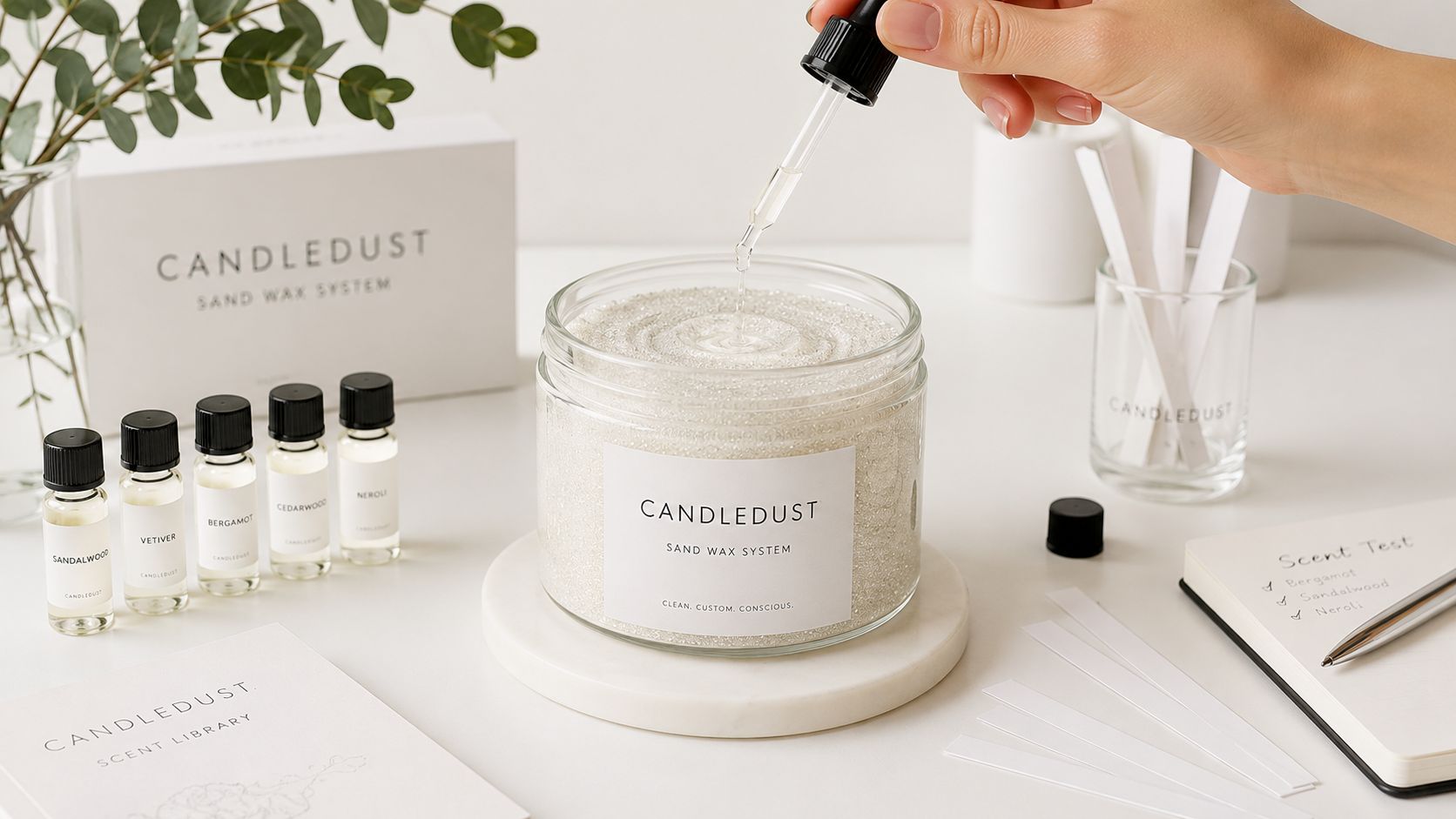
Traditional candle testing can get expensive because each trial usually means melting wax, pouring it, waiting, and then starting over. A sand wax system changes that workflow. You can pour a small batch into a heat-resistant vessel, add fragrance oil at the right load, insert a wick, and test the hot throw without committing to a full vessel.
Why the format helps testing
Once the burn is over, you remove the wick and reuse the remaining sand for the next blend. That makes it easier to compare a citrus-heavy version against a warmer one, or to adjust a floral pair without wasting a full batch. The process suits makers who want quick scent iteration, especially when testing combinations for events or decor setups.
The Candledust uses #Perfect pearl processing to create silky, smooth, even candle pearls without lumps and uneven particles. It also says the brand was one of the first sand wax candle producers in the world and the first to introduce scented sand candles. The refill formats are available in 350g, 650g, and 1000g, which gives you room to test small or larger concepts without changing the method (The Candledust beginner guide).
A simple trial workflow
Use a heat-resistant container, pour in the sand wax, add fragrance oil within the wax's safe load range, and place the wick. Then watch how the scent behaves as the candle warms up. If you're comparing two blends, note which one opens faster, which one stays steadier, and which one feels more balanced near the end of the burn.
The biggest advantage is practical, not decorative. You can test more combinations, throw away less material, and refine your formula with fewer barriers between idea and burn.
Your Next Steps for Confident Scent Blending
Start with the wheel, then move to the ratio, then test in wax. That order keeps you from guessing your way through the process. Use the 30-50-20 structure, respect fragrance load limits, and remember that cold throw and hot throw don't always tell the same story.
Pick two or three recipes from the section above and make small test batches first. Don't overload fragrance, don't skip the rest period, and don't judge a blend before the flame has had time to change it. If you're placing multiple candles in one room, think about scent collision before you think about decoration.
The best candle scent combinations come from curiosity shaped by method. Once you start treating scent as architecture instead of decoration, your results get calmer, clearer, and far more intentional.
If you want a cleaner way to test, refine, and reuse your candle ideas, The Candledust gives you a sand wax format that fits that kind of workflow. Explore the options, compare the refill sizes, and see how The Candledust can support your next scent blend from first draft to finished room.