

You're probably staring at a candle listing or a homemade scent idea and asking the same question a lot of people ask the first time they see it, is a bacon candle clever, ridiculous, or both? That reaction makes sense. Bacon sits in a strange place, it's familiar, comforting, a little funny, and loaded with memory, so the idea of turning it into a candle feels weirdly natural once you slow down and think about how scent works.
At the same time, bacon scented candles aren't just a joke in a jar. They sit inside a much larger scented-candle market that's big enough to support specialty fragrances, gifting lines, and seasonal novelty products, and they've been part of mainstream candle retail for years, not just internet humor. The key question isn't whether bacon can be a candle idea. It's what kind of bacon profile, what kind of wax base, and what kind of room fit makes sense.
Table of Contents
- Why Anyone Would Want a Bacon Scented Candle
- What Bacon Scent Actually Smells Like
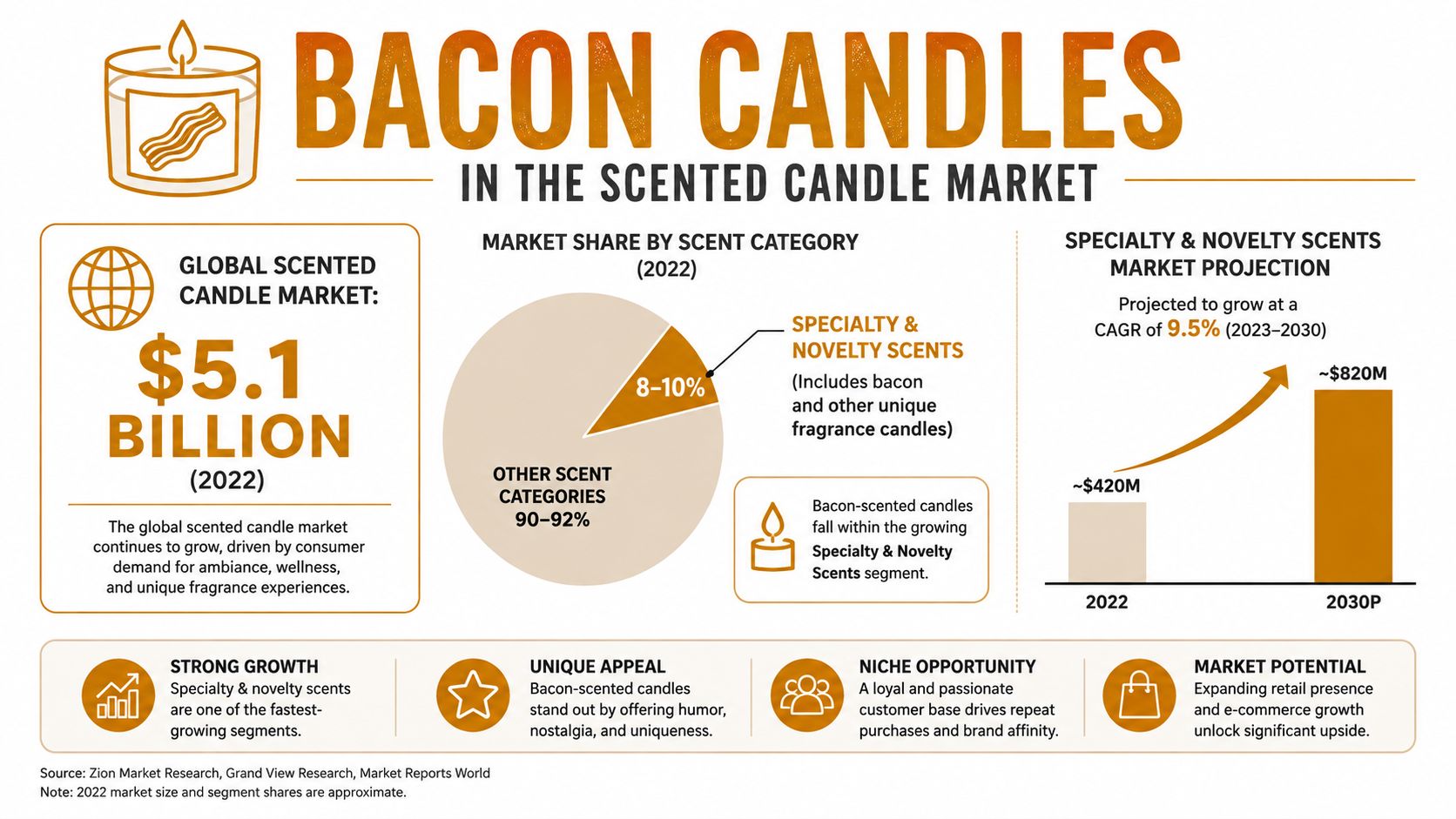
- Where Bacon Candles Sit in the Scented Candle Market
- Quality and Safety Considerations Before You Buy
- How to Make a Bacon Candle with Candle Sand and Fragrance Oils
- Gifting, Styling, and Room by Room Use
- Common Misconceptions and Quick Answers
Why Anyone Would Want a Bacon Scented Candle
A bacon scented candle usually gets attention the same way a strange brunch special does. People pause, smile, and then start asking who would buy it. That reaction is the point. It shows that novelty scents can do more than sit on a shelf, because they carry a mood, a memory, and a clear point of view.
The appeal is part memory, part humor, part gift logic
Bacon carries a strong link to breakfast, weekends, and comfort food, so even a candle that only hints at that idea can feel warm and familiar. The humor matters too. A bacon scented candle works as a conversation starter because the idea is unusual, but still easy to understand.
It also fits the way people choose candles as gifts. Buyers often look for atmosphere, personality, and the story behind the object, not just light. That is why bacon fragrances show up in gift-driven moments and why a major brand could market a bacon scent with Yankee Candle's “MMM, Bacon!” in its Man Candles collection.
Practical rule: novelty only works when the scent is wearable, not just funny on paper.
Bacon candles usually make the most sense when the buyer wants a playful signal instead of a quiet decorative object. They can say, “I know your sense of humor,” or “I know you like smoked, savory notes,” without taking themselves too seriously. That is a real use case, not a gimmick, and it helps explain why the category keeps coming back.
The more interesting part is that bacon candles are really a fragrance architecture question. A convincing savory candle has to balance smoke, salt, sweetness, and a little browned depth, much like a recipe that only works when each ingredient has a clear job. For readers who want that idea without locking themselves into a fixed commercial scent, a candle sand setup paired with fragrance oils offers a more flexible path. You can shape the savory side, soften it, or push it toward a cleaner breakfast note without buying whatever a brand decided bacon should smell like.
The lane is bigger than the joke
The broader scented-candle market leaves room for specialty scents like bacon. One independent estimate placed the global scented-candle market at a large scale and projected further growth, while another report also pointed to steady expansion, both suggesting a market that reaches well beyond basic utility candles (Data Bridge Market Research).
That context matters because bacon is not trying to compete with plain unscented candles. It sits in the premium, gifting, and experimentation lane, where unusual fragrance ideas can work if they feel deliberate. The main appeal is usually the mix of comfort and surprise, not a literal meat imitation.
What Bacon Scent Actually Smells Like
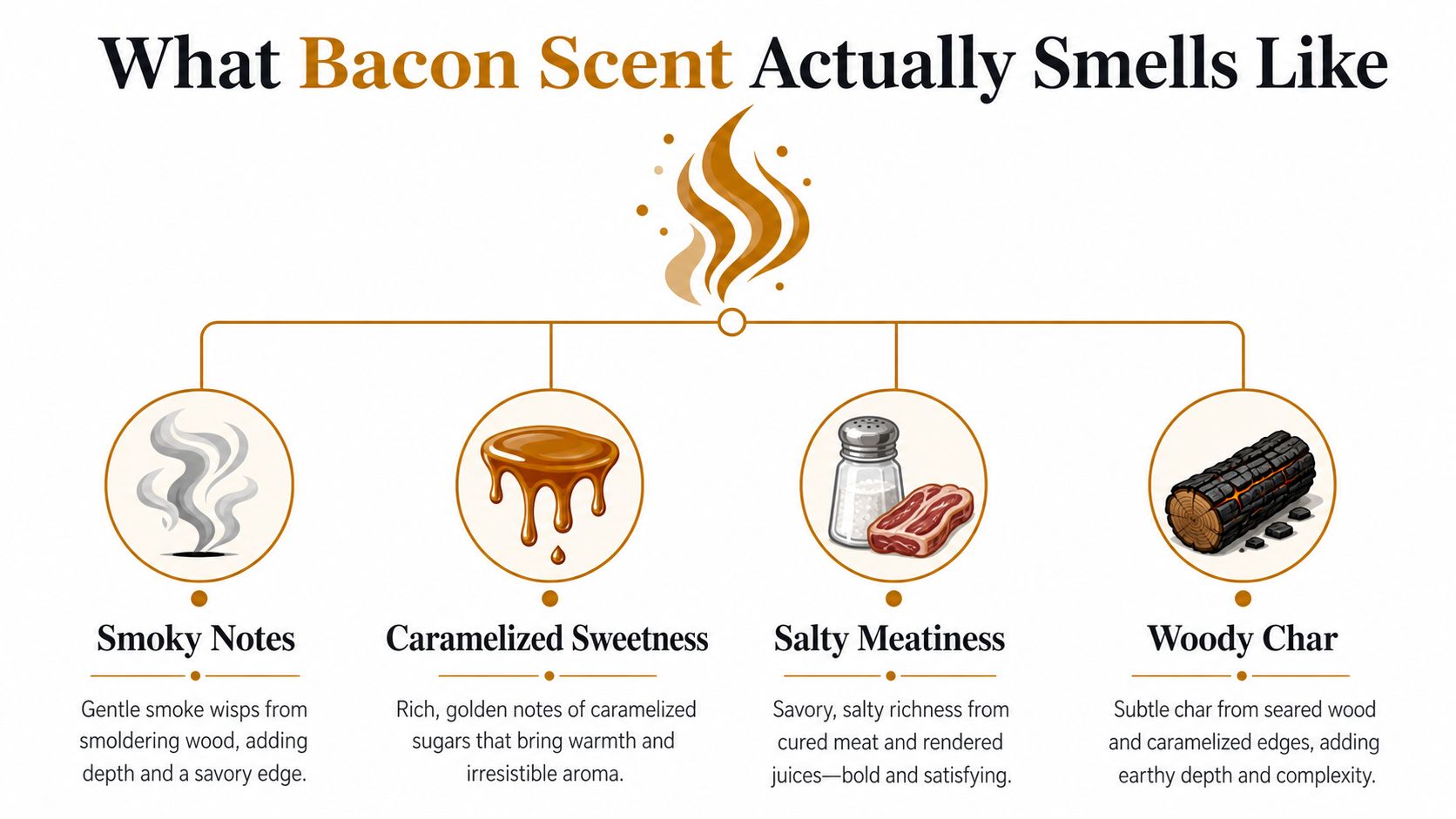
Bacon scent works because your nose doesn't need literal meat fat to recognize the idea. It just needs a blend that hits the same sensory cues, smoke, salt, caramelized sweetness, and a little roasted depth. It's like a brunch plate translated into aroma, where each smell note plays a role in the whole impression.
The odor is built from aroma molecules, not bacon itself
A bacon fragrance is typically made from a mixture of aroma molecules, not real bacon. One documented bacon-flavor formulation includes cyclotene, pyridine, diacetyl, guaiacol, isovaleric acid, acetic acid, furfuryl mercaptan, and pyroligneous acids, which shows how the “bacon” idea is reconstructed from smoky, sulfurous, caramelized, and fatty-acid-like notes rather than a single ingredient (The Good Scents Company).
That matters for candles because scent throw depends on how volatile molecules move from the warmed wax pool into the air. If the mix leans too smoky, it can feel harsh. If it leans too sweet, it can drift into maple dessert territory. Good bacon-style fragrance is really about balance.
A useful comparison is the way commercial products already present the scent. One listing breaks bacon fragrance into black pepper on top, bacon, maple, and salt in the middle, and dry cherrywood and musk at the base. That layered structure tells you something important, bacon candles are rarely just one flat note, they're built like a small fragrance story.
How to predict whether you'll like it
If you enjoy smoked woods, savory-sweet blends, or spicy kitchen-adjacent fragrances, bacon may feel charming instead of strange. If you strongly dislike smoke in a living room, the candle probably won't win you over, even if it smells accurate.
The easiest way to judge is to ask what kind of bacon idea you want. Some versions push maple and sweetness. Others lean peppery or hickory-heavy. A product like Dark Honey Scented Candle Sand 1Kg / 2.20lbs shows how a sweet note can be paired with a delicate smoky edge, with top notes of honey and tobacco, heart notes of tobacco, and a tonka base.
If you want to compare formulation choices more closely, the discussion around fragrance oil and essential oil use in candles is worth reading in the context of scent architecture, not just ingredient labels. The same scent family can feel totally different depending on the balance of smoke, sweet, and woody notes, which is why fragrance oil versus essential oils becomes a practical question, not just a technical one.
Where Bacon Candles Sit in the Scented Candle Market
A bacon candle makes more sense once you place it inside the larger scented candle market. It is not a random prank item sitting outside the category, it is one small branch of a broad fragrance business that already has room for unusual scents, decorative packaging, and giftable formats. A beginner can picture the category the way a bakery case works. The standard loaves do the heavy lifting, while a few specialty items catch the eye and signal personality.
Specialty scents have room to exist inside a large category
Market research from Data Bridge Market Research shows that the scented candle field is large enough to support niche ideas and still keep growing. The exact size estimates vary by report, but the point is consistent. This is a category with space for candles that smell like dessert, woods, flowers, clean laundry, and yes, bacon-inspired blends. That breadth is what lets a novelty fragrance move from a joke into a product with a real audience.
In practical terms, bacon candles usually sit in premium, novelty, and gift channels. Those are the shelves, online or in store, where a candle can sell through personality, packaging, and scent story as much as through everyday usefulness. A product does not have to be a household staple to find buyers there. It only has to feel intentional and clear about what kind of mood it is offering.
Key takeaway: bacon candles do not need broad appeal to belong in the market.
Online discovery also matters. Scented candles travel well on product pages and social feeds because buyers can react to the name, the image, and the concept before they ever smell the wax. A novelty fragrance often gets its first chance through curiosity, then earns a second look if the scent structure sounds believable. The same logic explains why a candle like the Elia 1986 candle 6.5oz can be useful as a reference point, since it shows how presentation and fragrance identity work together in a candle meant to be noticed.
The market favors fragrance architecture, not just punchlines
That is where bacon candles stop being a kitchen gag and start becoming a fragrance design question. A good novelty candle still needs a structure that makes sense in the room, with the smoky part, the sweet part, and the savory hint arranged so the scent feels deliberate instead of chaotic. The same basic idea shows up across modern candle making. Consumers respond better when a scent has a readable shape, almost like a song with a verse, chorus, and finish.
For readers who want to understand that design side more clearly, non-toxic candle wax choices give a useful way to think about the base that carries any fragrance. Wax is the stage, fragrance is the performance, and wick choice decides how well the room hears it. That matters even more with a bacon profile, because an overly heavy base can flatten the savory notes while an overly hot burn can push the scent toward smoke instead of fragrance.
The same thinking is what makes a custom sand-candle format interesting. A fixed commercial candle gives you one interpretation of bacon. Candle sand lets you build your own version, adjusting the smoky edge, the sweet note, or the woody finish until it fits your space. That is a different kind of value than a shelf product, but it belongs to the same market conversation, because both are about how fragrance gets composed, sold, and experienced.
Quality and Safety Considerations Before You Buy
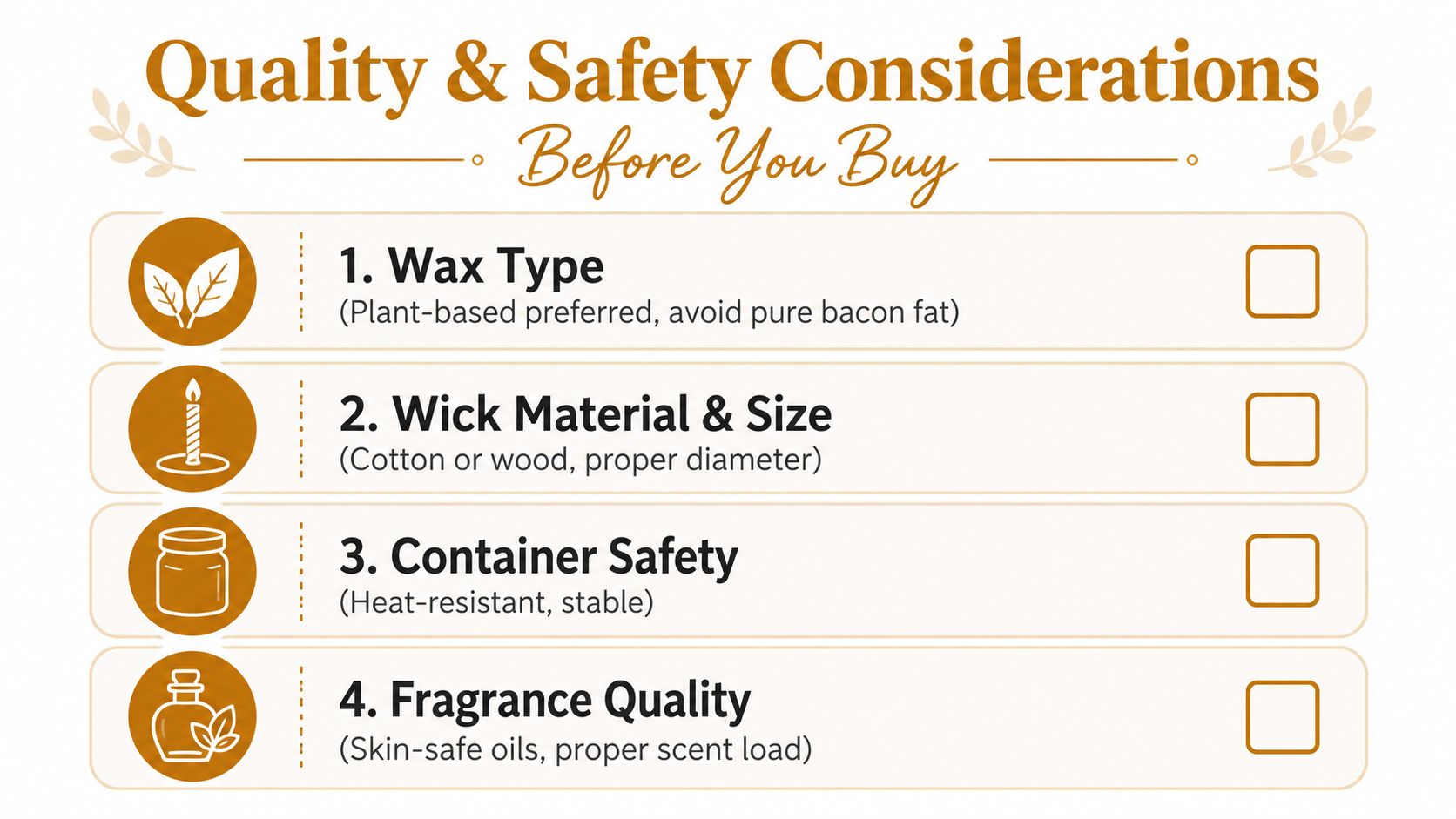
A bacon candle can look playful on a shelf and still deserve the same inspection you would give any other home fragrance. Before you buy, check the wax, the wick, the container, and the fragrance notes. Those details tell you whether the candle is built to burn cleanly or just built to attract attention.
Wax and wick are the first things to check
A finished candle is safer when it uses a controlled wax base instead of literal bacon fat. Some DIY recipes may mention blending bacon grease with soy wax, but safety guidance warns against loading the candle with too much grease and recommends keeping the grease share at about 50% or less (YouTube guide). Bacon fat also melts at around 38 to 42°C, and unsaturated fats can oxidize and release more VOCs when heated above 200°C (YouTube guide). That is a lot to ask of a candle that is supposed to behave predictably in a room.
A plant-based wax base is easier to trust for an indoor novelty candle. The wick matters just as much. A wick that is too large can make the flame run hot and smoky. A wick that is too small can leave the wax tunneling down the middle and keep the scent from spreading well.
Practical rule: if the candle smells like burning instead of fragrance, the design needs work.
For a fuller look at wax choices, non-toxic candle wax is a useful reference because the wax base shapes how steady the burn feels. Wax is the body of the candle, and the wick is the part that controls how that body behaves under heat.
Container safety and scent throw should feel ordinary
A bacon candle still needs a heat-resistant container that stays stable while burning. Playful packaging is fine, but the jar should act like a normal candle jar. If the container runs hot, feels narrow at the rim, or tips too easily, the novelty is not worth the risk.
Scent throw is the last check. A good bacon candle should smell readable when cold, then open up without turning harsh when lit. The fragrance should feel savory, smoky, and a little sweet, not like a burnt pan or a kitchen left unattended.
The smartest buying habit is simple. Look for a stable wax base, a wick matched to the vessel, a container built for heat, and a fragrance description that tells you whether the candle leans smoky, sweet, peppery, or woody. Those details say more about the candle than the joke on the label.
How to Make a Bacon Candle with Candle Sand and Fragrance Oils
Candle sand is a smart format for this kind of project because it turns the candle into a refillable design choice instead of a one-time wax pour. You don't need to melt a block of wax, and you can reuse the vessel after the wick is replaced, which makes experimentation feel much less risky. That fits bacon fragrance especially well, because people often want to test a novelty scent without committing to a fixed jar.
Build the candle as a scent test, not a chemistry stunt
Start with a heat-resistant vessel, then pour in silky, smooth, even candle pearls so the surface looks uniform and the wick sits securely. If the sand is lumpy or uneven, the burn can become patchy, which is why the texture matters so much. The product promise here is straightforward, #Perfect pearl, meaning the particles are designed to stay smooth and consistent rather than clump.
The basic sequence is simple. Set the wick in the center, add the sand around it, and keep the top level. If you're mixing fragrance yourself, dose it lightly at first, because bacon is a strong family of notes and it doesn't need much help to read clearly. A bacon-plus-smoke blend often makes more sense than a pure meat impression, since the smoky edge keeps the scent wearable in a room.
One useful reference point for DIY candle handling is DIY candle making at home, especially if you want a low-mess process that doesn't rely on melting a pot of wax.
Let the fragrance stay controlled
After the wick is placed, let the candle sit so the fragrance settles through the sand before the first burn. That gives the top layer a better chance to light evenly. When you do burn it, keep the first session moderate rather than letting the flame run long and hot right away.
Helpful habit: a cleaner first burn usually gives you a cleaner scent story later.
If you want a sand-based format that already fits the idea of clean, reusable candle design, The Candledust is one option in this category. Its candle sand format is meant to be poured into a vessel with a wick, then reused by replacing the wick and keeping the remaining sand, which suits experiments like bacon fragrance because you can adjust the scent without starting from scratch. For a tactile look at the kind of product this format can support, the screenshot below gives a visual reference.

Gifting, Styling, and Room by Room Use
Bacon candles work best when you match the scent to a room that can carry a little humor without losing comfort. A breakfast nook is the obvious place, since the fragrance cue and the setting line up naturally. A kitchen can also work, especially if the candle leans smoky rather than greasy.
The room changes the joke into a mood
A den, man cave, or study can make more sense than people expect, because smoky and woody notes can sit beside dark furniture, leather, and low light. That doesn't mean bacon belongs everywhere. It means the scent can feel intentional when the room already supports heavier, more textured aromas.
The gift angle is where bacon candles often shine. Father's Day, groomsmen gifts, bachelor parties, and housewarmings for the friend who already owns every standard candle are all natural fits. The candle feels like a personality statement, but only if the container and label look deliberate rather than cheap.
If you want to style a bacon candle as an object, the vessel matters as much as the scent. Browsing decorative Jadyn candle holder options is a useful way to think about presentation, because the right holder can make a novelty candle look like a designed accent instead of a prank.
Sand format gives the vessel a second life
The nicest part of the sand approach is what happens after the bacon phase is over. You can replace the wick and repurpose the same container for a different scent, so the vessel doesn't get locked into one joke forever. That's especially useful for gift candles, because the recipient can enjoy the novelty once, then move on to a more neutral fragrance later.
This is why bacon candles can work as both a short-term conversation piece and a longer-term decor object. The first burn gets the laugh. The second scent, if you swap it, gets the room back into everyday life.
Common Misconceptions and Quick Answers
People tend to assume a bacon candle has to be one of two things, either a gag that smells like a fryer, or a cheap novelty item that can't possibly burn well. Both assumptions miss how fragrance products work. Bacon candles are usually built from fragrance chemistry, and the better ones are shaped more like layered scents than literal meat replicas.
The fastest myth resets
A bacon candle is not usually made from real bacon. Consumer products rely on aroma formulas, not slices of pork in wax, and that's true whether the result smells smoky, sweet, or peppery. It's also not limited to the kitchen. Smoky bacon notes can sit comfortably in a den, a gift basket, or a novelty display if the profile is balanced.
Novelty doesn't automatically mean low quality either. A candle can be playful and still have good wax, a proper wick, and a stable vessel. The test is whether the candle smells intentional when cold and clean when lit.
Short answer: bacon scent works best when it reads as a fragrance family, not as breakfast leftovers.
Three practical questions come up most often. If you're dosing fragrance, start light and build only if the scent reads too faint. If you want a summer-leaning bacon scent, a lighter smoky or peppery profile usually feels easier than a heavy maple blend. If you want a winter feel, sweeter and woodier notes can seem more fitting.
Another common question is whether bacon pairs with other candles. It can, but only when the companion scent supports the same mood, such as smoke, wood, spice, or subtle sweetness. Avoid mixing it with very bright floral candles unless you want a clash.
If you want to explore candle sand as a cleaner way to test bold fragrances like bacon, The Candledust offers a refillable format that lets you pour, light, and then reuse the vessel with a new wick. Visit The Candledust to see how that approach can turn a novelty scent into a flexible home-fragrance ritual.